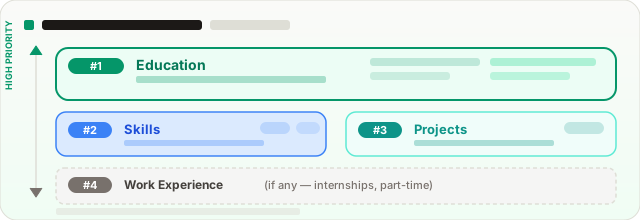
Entry-level candidates fail ATS not because they lack experience, but because they use a senior candidate's resume structure with junior content. The optimal section order for new graduates flips the standard format: Contact, Summary, Education, Skills, Experience, Projects. This front-loads keyword-rich sections before your weakest one. Most postings requesting 2 to 3 years of experience accept candidates with 1 year plus 2 relevant internships or projects.
You graduated last month. Your resume has one internship, two class projects, and a lot of white space. Every job posting asks for 2-3 years of experience you don’t have. The good news: ATS systems score section by section, and the default resume order - Contact, Experience, Education, Skills - is the worst possible structure for an entry-level candidate. Flip it. Lead with Contact, Summary, Education, Skills, Experience, Projects. This front-loads keyword-rich sections before the one where you’re weakest.
ATS systems were built around the assumption that candidates have work history: job titles, employers, tenure, and achievement bullets drawn from years on the job. For entry-level candidates and new graduates, that assumption creates a structural scoring disadvantage that cannot be fixed by simply writing better bullets. You need a different architecture.
The good news is that the disadvantage is manageable. The candidates who struggle most with ATS as new grads are not the ones with the least experience. They are the ones who try to use a senior candidate’s resume structure with junior candidate content. The fix is getting the structure right, then populating it with the right kind of content.
The Entry-Level ATS Problem in 2026
Competition for entry-level roles has intensified. A corporate entry-level position at a recognizable company in finance, technology, consulting, or marketing commonly receives 300–800 applications within the first 72 hours of posting. At that volume, ATS filtering is not a formality. The recruiter who sees your resume at all is likely seeing only the top quartile of applicants by score.
The candidates who struggle most with ATS as new grads are not the ones with the least experience. They are the ones who try to use a senior candidate’s resume structure with junior candidate content. Placing experience before education and skills means leading with your weakest section. Flipping the order to put skills and education first gives ATS systems the keyword-rich content they weight most before encountering the thin work history.
The scoring disadvantage for new grads is structural: ATS systems look for years of experience, job title history, and keyword density in work descriptions, all of which favor candidates who have been in the workforce longer. A 22-year-old applying for their first analyst role cannot fix this with creativity. They can fix it with the right resume structure, a targeted skills section, and ATS-compatible content drawn from academic and extracurricular experience.
The Right Resume Structure for 0–2 Years of Experience
The standard senior-candidate structure (Summary, Experience, Skills, Education) is not optimal for entry-level candidates. Experience is your weakest section. Putting it before your education and skills is leading with your least competitive content.
The structure that performs better for new graduates:
Contact Information → Summary → Education → Skills → Experience → Projects
This order logic is strategic:
- Summary immediately establishes your candidacy and includes high-priority keywords
- Education is your primary credential, and it belongs near the top when it is recent and relevant
- Skills front-loads your technical keyword coverage before the experience section
- Experience covers internships, part-time work, and relevant employment in chronological order
- Projects captures academic and independent work that would otherwise be buried or omitted
As you accumulate 2–3 years of professional experience, migrate the structure toward the standard order. At the entry level, leading with your strengths means leading with education and skills. On page length: nearly all entry-level candidates should use a single page — see one page vs two page resume for the full breakdown by career stage.
The Education Section for New Graduates
For most new grads applying through ATS, the education section carries more weight than it ever will again in your career. Use it accordingly.
Core information: Degree, institution, graduation date (month and year). GPA should be included if it is 3.5 or above on a 4.0 scale. Below 3.5, omit it, since it adds a negative signal where there was previously no signal.
Relevant coursework: List individual courses that directly relate to the role. Do not list every course from your transcript. For a data analyst application: “Statistical Analysis, Machine Learning Fundamentals, Database Management, Linear Algebra.” For a finance application: “Corporate Finance, Financial Statement Analysis, Derivatives and Risk Management, Econometrics.” Keep the list to 6–8 courses and use the exact course names from your institution, since these are often searchable keywords.
Honors and academic recognition: Dean’s List (include which semesters), departmental honors, any relevant academic awards. These belong in the education section, not scattered through a summary.
If you hold any professional certifications, the guide on formatting certifications for ATS explains how to list them so they register correctly in keyword extraction.
Extracurricular activities and student organizations: Only those relevant to the role or indicative of leadership and professional competence. The treasurer of your student investment fund is relevant for finance roles. A case competition team where you placed at a regional level is worth noting. Student government or varsity athletics signals leadership and commitment but contributes less to ATS keyword matching.
Internships and Part-Time Work: Format Them Like Full Jobs
This is one of the most important structural decisions an entry-level candidate makes: how to present internship experience.
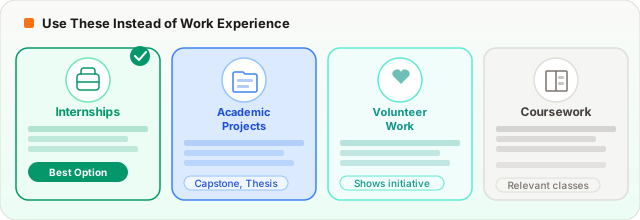
In ATS terms, an internship is a job. It has a company name, a title, dates, and deliverables. The system does not distinguish between “Intern” and “Associate” when parsing work history. It extracts the title, the employer, the dates, and the content of your bullets. What matters for scoring is the content of those bullets, not the label.
Format every internship and part-time position exactly as you would a full-time professional role:
Marketing Analytics Intern                      June 2025 – August 2025
[Company Name] | New York, NY

• Analyzed campaign performance data in Google Analytics and Tableau
  for 12 active marketing campaigns across paid and organic channels
• Built Python scripts to automate weekly reporting, reducing prep time
  from 4 hours to 30 minutes per report cycle
• Presented findings to marketing director and two product managers
  in weekly data review meetings
The specific tools (Google Analytics, Tableau, Python), the quantified outcomes (4 hours to 30 minutes), and the scope (12 campaigns) are the content that drives keyword matching and gives both ATS and human reviewers meaningful signal. “Assisted with marketing analytics” and “supported the team on various projects” are not substitutes.
Academic Projects: Write Them as Experience
Most new graduates have completed projects (in coursework, in student organizations, or independently) that involved real skills and real deliverables. These belong on the resume, structured as experience entries rather than one-line mentions.
A project entry should include: the project name, the context (course, hackathon, independent), a date or semester, and 2–3 achievement bullets written with the same specificity as a work experience entry.
Weak format:
Capstone Project – Supply Chain Optimization
Analyzed supply chain inefficiencies for a fictional manufacturer.
Strong format:
Supply Chain Optimization - Senior Capstone Project      Fall 2025
• Built linear programming model in Python to minimize logistics costs
  across 14 distribution nodes; identified 12% cost reduction opportunity
• Analyzed five years of historical shipment data using pandas and SQL
• Presented recommendations to panel of industry judges; placed 2nd
  among 18 competing teams
The specificity, the tools, the scope, the outcome: these are keyword-rich and describe genuine competence. ATS systems parsing this as work-equivalent experience will extract Python, SQL, pandas, linear programming, supply chain, and logistics as skill signals.
Volunteer Work and Student Organizations
Volunteer experience and meaningful student organization roles are viable experience entries for ATS purposes, provided they involved real responsibilities with describable outcomes.
The standard to apply: would you describe this work the same way to a professional contact at a networking event? If yes, it belongs on the resume in structured form. If it was primarily social or involved minimal responsibility, it should be omitted rather than padded.
Student organization roles with responsibility (treasurer managing a budget, event chair coordinating logistics, technical lead for a project) can be formatted as experience entries using the same structure as employment. The organization functions as the “employer,” your role is the title, and the bullets describe specific work and outcomes.
The Skills Section Is Your Main Keyword Vehicle
For entry-level candidates, the skills section carries a disproportionate share of the keyword-matching burden. Your work experience bullets are shorter and fewer than a senior candidate’s. Your skills section is where you establish explicit coverage of the tools and technologies the job description requires. The resume skills section guide walks through how to structure and populate it for maximum ATS coverage.
Include every technical tool, platform, language, and methodology you have genuine exposure to: from coursework, from projects, from internships, from self-directed learning. Do not include things you saw briefly in one tutorial video and cannot describe in a conversation. But do not undersell. If you built projects in a language or worked with a platform across multiple assignments, it belongs in your skills section.
For most entry-level candidates in technical or analytical fields, 15–25 skills is appropriate. For non-technical roles, 10–18 specific skills are more typical.
The GitHub and Portfolio Problem
ATS systems do not visit URLs. Your GitHub profile, your portfolio website, your Behance page: none of this content is visible to the parser. The link appears in your resume as a URL string and is either stored as contact metadata or ignored.
Since you cannot rely on your portfolio to show your work to ATS, you must describe your work within the resume text itself. The specific technologies, project outcomes, and competencies demonstrated in your portfolio need to appear as keywords in your resume bullets and skills section, not only as visual work in an external URL.
Include portfolio links anyway, since they matter at the human review stage. But treat them as a supplement to, not a substitute for, detailed in-resume descriptions of your projects and technical skills.
Targeting the Right Entry-Level Roles
“Entry level” in job posting language covers a wide range. Some postings use “entry level” as a label while describing requirements (2 years of experience, specific certifications, advanced technical skills) that exclude genuine new graduates. Others are accurately described and realistic for recent graduates.
Before tailoring your resume to a posting, verify that the requirements are achievable for your background. If a posting labeled “entry level” requires 3+ years of experience in a specific platform, it is a mislabeled job description, not a calibration error on your resume.
For roles that genuinely fit your background, the tailoring process is the same as for experienced candidates: compare the job description’s required skills against your resume, add missing terms where they apply honestly, and ensure your summary and skills section reflect the language of this specific posting. The difference is that entry-level applications require somewhat more tailoring time per application because your keyword coverage starts further from the job description’s requirements.
The 2026 Reality: ATS Cutoffs Are Harsher at Entry Level
The math is unfavorable. A hundred senior-level applicants to a VP-level role represents a manageable review pile. A hundred entry-level applicants to an analyst role is the low end of what most corporate employers see. At 300–500 applicants, ATS cutoffs become more aggressive to create a manageable review pool.
This means entry-level candidates are filtered by ATS more aggressively, not less, despite having less experience to demonstrate. The keyword matching threshold that results in appearing in the recruiter’s review queue may be higher than what an equivalent senior candidate needs to clear.
Tailoring is not optional for entry-level applications. The 15-minute tailoring workflow is especially valuable here because it makes targeted customization sustainable at volume. A generic resume submitted to 50 roles will clear the ATS filter at a much lower rate than 10–15 highly tailored submissions where the keyword alignment is strong. The volume-over-quality approach produces a worse outcome for new graduates than for experienced candidates who have more inherent keyword coverage.
Application Volume Strategy
The ceiling for high-quality tailored applications is approximately 10–15 per week for most candidates. Each requires reading the job description carefully, adjusting the skills section to reflect the specific tools and requirements emphasized in the posting, and revising the summary to use the language of this role.
Below that threshold of tailoring, you are submitting a resume that is likely to score poorly in ATS regardless of how strong your actual background is for the role.
For entry-level candidates, the research phase matters as much as the application phase: identify which companies have active entry-level programs, which ATS platforms they use (this affects formatting decisions), and whether the posting is realistically appropriate for your background. Targeted research before widespread application produces better results than the alternative.
Key takeaways
✓ Flip the section order — Contact, Summary, Education, Skills, Experience, Projects puts your strongest content first for entry-level candidates
✓ Internships are jobs — format every internship with company, title, dates, and quantified bullet points; ATS parsers do not distinguish between “Intern” and “Associate” when scoring
✓ Skills section carries the keyword burden — list every tool, platform, language, and methodology with genuine exposure; this is where keyword matching happens before the sparse experience section
✓ Tailoring is not optional — entry-level ATS cutoffs are often more aggressive than for senior roles because of higher application volume; generic resumes score poorly
ATS CV Checker is particularly useful for entry-level candidates because the gap between your resume and any given job description tends to be larger and harder to self-assess. Pasting a job description alongside your resume surfaces the specific skills and terms that are required or preferred in the posting but absent from your current document, telling you exactly what to add, where, and in what language, before you submit.