Healthcare ATS systems go beyond keyword matching. Many verify NPI numbers against the NPPES registry and parse state license expiration dates in real time. Physicians should include their NPI number in the contact section. Nurses need licenses formatted with state, license number, and expiration date. EHR system names like Epic, Cerner, and Meditech must appear verbatim to register as matched skills.
A licensed nurse practitioner with 12 years of clinical experience applies through a hospital’s career portal and never hears back. The problem isn’t qualifications. Healthcare ATS systems go beyond keyword matching. They verify NPI numbers against the NPPES registry, parse state license numbers and expiration dates, and check board certifications. Physicians should include their NPI in the contact section. Nurses and allied health professionals need licenses formatted with state, number, and expiration date. EHR system names like Epic, Cerner, and Meditech must appear verbatim.
Healthcare hiring has two layers that most industries do not: credentialing verification and licensure checking. An ATS in healthcare is not just matching skills - it is often pulling license data against state verification databases and checking whether your NPI number exists in the NPPES registry. Understanding these layers changes how you format your resume.
Healthcare ATS systems do more than match keywords. Many verify credentials in real time against external registries, including the NPPES for NPI numbers and state licensing boards for nurses and allied health professionals. A license listed without its state, number, and expiration date may not register as a valid credential, even if you are fully licensed.
This guide covers physicians, nurses, allied health professionals, and healthcare administrators. The ATS behavior differs somewhat across these roles, so we will note where the guidance is role-specific.
How Healthcare ATS Systems Are Different
General corporate ATS platforms like Workday and Taleo are also used in healthcare, but many large health systems use healthcare-specific platforms: Kronos (now UKG), Infor Healthcare, or custom-built credentialing systems. Smaller practices often use simpler ATS products.
The healthcare-specific platforms have additional parsing modules for:
- NPI (National Provider Identifier) lookup
- DEA registration status
- State license number extraction
- Board certification verification
- USMLE scores (for physician roles)
- Clinical specialty keywords mapped to ICD-10 categories
For roles in nursing, allied health, and clinical leadership, most hospitals use either Taleo or Workday with healthcare-specific configurations. These configurations add weight to licensure, certifications, and clinical experience keywords that general configurations ignore.
NPI Numbers: Include or Not?
Your NPI number is public information, listed in the NPPES (National Plan and Provider Enumeration System) database. For physician roles, including your NPI in your contact information is standard. Some healthcare ATS systems use it to auto-populate your specialty, practice history, and insurance participation from public records.
Format: “NPI: 1234567890” in your contact section, alongside your DEA registration number if applicable.
For nurses and allied health professionals at the staff level, NPI inclusion is optional. For advanced practice providers (NPs, PAs, CRNAs) and physicians, include it. Hospital credentialing departments will pull this information regardless; including it signals familiarity with the process.
Licensing: How to Format It So ATS Finds It
License numbers need to be formatted predictably. ATS credentialing modules parse license entries using pattern matching, looking for state abbreviations, license numbers, and expiration dates.
Registered Nurse: “RN License, State of California (License #RN-123456, Expires 12/2027)” - include state, type, number, and expiration.
Advanced Practice: “APRN, California Board of Registered Nursing (License #NP-45678, Expires 06/2026)” and separately: “Nurse Practitioner, Family Practice (AANP Board Certified, 2022)”
Physician: “MD, licensed in New York (License #MD-789012), Massachusetts (License #MA-234567)” - list all active state licenses. Multi-state licensing through the Interstate Medical Licensure Compact (IMLC) should be noted: “IMLC participant (10 states).”
Physician Assistants: “PA-C, NCCPA Board Certified (Certificate #PA-345678)” and your state license separately.
The critical point: Create a dedicated “Licensure & Certifications” section in your resume. Do not bury these in the body of your experience or your skills list. Healthcare ATS systems weight a recognized “Licensure” section header differently than general text.
EHR System Names: Be Specific
Electronic Health Record experience is one of the most weighted skill factors in clinical staff hiring. The system names you list have significant impact on your ATS score.
Do not write: “Experience with EHR systems” or “Proficient in electronic medical records.”
Write the specific system names:
- Epic (and note the module if relevant: Epic Inpatient, Epic Ambulatory, Epic MyChart, Epic Stork for OB)
- Cerner (now Oracle Health)
- Meditech (specify: Meditech Expanse, Meditech Magic, Meditech 6.0)
- Allscripts
- athenahealth
- eClinicalWorks
- MEDITECH
- NextGen
- Greenway Health
- DrChrono
Epic certification or training: if you have completed Epic training modules or hold an Epic certification (Epic certification levels vary by module), list this explicitly: “Epic Certified: Ambulatory and InBasket modules.” Many health systems use Epic configuration as a filter, and Epic certifications are heavily weighted in their ATS configurations.
HIPAA: What to Actually Write
Nearly every healthcare professional has HIPAA compliance experience by default. Writing “HIPAA compliance” as a standalone skill does not differentiate you; every candidate has it.
Write it with context:
- “Developed HIPAA-compliant data sharing protocols for multi-site research study involving 12,000 patient records”
- “Trained 45-person nursing staff on HIPAA Privacy Rule requirements following 2023 policy revision”
- “Conducted HIPAA risk assessment under HITECH Act requirements, producing remediation plan approved by Privacy Officer”
The distinction: “HIPAA compliance” as a bare bullet is table stakes. Demonstrating what you actually did with HIPAA requirements tells an ATS you have operational experience, not just awareness.
For healthcare IT and compliance roles, include related frameworks: “HIPAA Security Rule (45 CFR Part 164),” “HITECH Act,” “NIST Cybersecurity Framework for healthcare,” “SOC 2 Type II.”
Clinical Keywords by Specialty
Your resume keywords need to match the specialty-specific language a hiring manager would use and an ATS would be trained on. These are not generic; use the specific clinical terminology.
Emergency Medicine / Trauma: Triage, ACLS, ATLS, TNCC, trauma activation, mass casualty incident (MCI), emergency department throughput, door-to-provider time, pain management protocols, sepsis protocol, stroke protocol.
Critical Care / ICU: Mechanical ventilation, ventilator management, arterial line insertion, central line management, CRRT (continuous renal replacement therapy), vasoactive medications, sedation management, ABCDEF bundle, RASS scale, CAM-ICU.
Perioperative / OR: Surgical counts, sterile field maintenance, circulating nurse, scrub technician, PACU, anesthesia monitoring, instrument processing, laparoscopic procedures, robotic surgery (specify platform: da Vinci), SCIP measures.
Labor and Delivery / OB: Fetal monitoring, electronic fetal monitoring (EFM), Category II/III fetal heart tracings, oxytocin administration, postpartum hemorrhage (PPH) protocol, shoulder dystocia, vacuum/forceps delivery, cesarean section, AWHONN guidelines.
Oncology: Chemotherapy administration, biotherapy, immunotherapy, vesicant management, PICC line management, port access, neutropenic fever protocol, FACT-G, palliative care, hospice transition, ONS Chemotherapy and Biotherapy certification.
Primary Care / Family Practice: Annual wellness visit (AWV), chronic disease management, preventive care measures, PCMH recognition, HEDIS measures, panel management, care coordination, Medicare Annual Wellness Visit, HCC coding.
Certifications: Full Name Plus Acronym
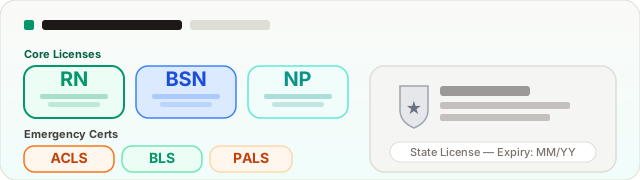
Healthcare certifications are abbreviated so universally that candidates often only list the acronym. ATS systems trained on healthcare resumes generally recognize the major acronyms, but some do not. List both.
| Certification | How to Write It |
|---|---|
| BLS | Basic Life Support (BLS), AHA |
| ACLS | Advanced Cardiovascular Life Support (ACLS), AHA |
| PALS | Pediatric Advanced Life Support (PALS), AHA |
| TNCC | Trauma Nursing Core Course (TNCC), ENA |
| CEN | Certified Emergency Nurse (CEN), BCEN |
| CCRN | Critical Care Registered Nurse (CCRN), AACN |
| CNM | Certified Nurse-Midwife (CNM), AMCB |
| CRNA | Certified Registered Nurse Anesthetist (CRNA), NBCRNA |
| CPC | Certified Professional Coder (CPC), AAPC |
Include the issuing body (AHA, AACN, AAPC) and the expiration date for each certification that expires. Many healthcare ATS systems filter out candidates whose certifications have lapsed.
Healthcare Administration and Non-Clinical Roles
For healthcare administrators, revenue cycle managers, quality improvement specialists, and health IT professionals, the keyword set is different from clinical roles.
Revenue Cycle: ICD-10-CM, ICD-10-PCS, CPT coding, HCPCS Level II, denial management, prior authorization, claims adjudication, EOB, payer contracting, net collection rate, days in AR, clean claim rate, remittance processing.
Quality and Patient Safety: CMS Conditions of Participation, Joint Commission (TJC), DNV GL Healthcare, NCQA accreditation, HEDIS, Press Ganey, HCAHPS, Leapfrog Group, Never Events, RCA (root cause analysis), FMEA, PDSA cycle, Lean Six Sigma in healthcare.
Health IT: HL7 FHIR, HL7 v2.x, CCD/CDA documents, SMART on FHIR, USCDI, interoperability, API integration, EHR implementation, go-live support, super-user training, interface engine (Rhapsody, Mirth Connect).
Resume Format Decisions for Healthcare
Healthcare ATS systems generally handle single-column PDFs without issues. The formatting guidance from general ATS best practices applies: no tables for your experience, no graphics, contact info in document body not header.
One healthcare-specific consideration: length. For physicians, a curriculum vitae (CV) rather than a resume is standard in academic medicine and many hospital systems. A CV can be 5-10+ pages and includes publications, presentations, teaching appointments, committee service, and research. For community hospital clinical staff, a 2-page resume is standard. Know which format the role expects.
If submitting a full CV through an ATS portal that converts it to a parsed profile, note that parsers often struggle with lengthy CVs. The most important credentials, licenses, and recent experience should appear in the first two pages, since ATS systems weight early content more heavily.
For nursing and allied health, a two-page resume is the norm. Lead with your most recent position, your licensure, and your certifications. Clinical skills should appear prominently in a dedicated section, since this is heavily weighted in staff-level ATS screening.
Key takeaways
✓ NPI in contact section — physicians and advanced practice providers should include their NPI number; it enables auto-population from public records
✓ License format — include state, license number, and expiration date for every active license; incomplete entries may not register as valid
✓ EHR system names verbatim — “Epic Ambulatory” and “Cerner Millennium” score; “EHR experience” does not match specific platform filters
✓ Certifications with issuing body — write “Basic Life Support (BLS), AHA” so both the acronym and the authority are searchable
✓ HIPAA with context — “HIPAA compliance” alone is table stakes; describe what you actually did with HIPAA requirements
Run your healthcare resume against the specific job posting before applying. Healthcare job descriptions often include specific EHR platforms, certifications, and specialty requirements in the preferred qualifications section. Those terms need to appear in your resume.