Finance and banking roles use some of the strictest ATS filters of any industry. CFA and CPA credentials must include the issuing body ("CFA Institute," "AICPA") to pass credentialing checks. Bloomberg Terminal should appear as "Bloomberg Terminal (BLP)" rather than just "Bloomberg." Role-level vocabulary mismatch, such as using Director-level language on an Associate application, can reduce your match score by 20 points or more.
Finance and banking applicants hit some of the strictest ATS filters in any industry. Generic business language that works for other fields gets screened out immediately. CFA, CPA, and FINRA licenses must be listed with full names and issuing bodies to be parseable. Bloomberg Terminal should be written as “Bloomberg Terminal (BLP)” rather than just “Bloomberg.” Role-level keyword matching matters here more than in most industries: using Director-level language on an Associate application reduces your score.
Finance and banking hiring is more keyword-dense than most industries. A VP of Credit Risk at a regional bank and a VP of Credit Risk at a bulge bracket firm are not interchangeable roles, and the ATS knows it. The screening systems at Goldman, JP Morgan, and even mid-market asset managers have been trained on hundreds of thousands of finance resumes, and they look for very specific signals beyond generic business language.
Here is what those signals are, and how to include them correctly.
Why Finance ATS Screening Is Different
Most industries screen for a mix of hard and soft skills. Finance ATS systems, particularly those used by investment banks, private equity firms, asset managers, and the Big Four, screen heavily for credentials, certifications, and tool proficiency. The reason is simple: regulatory compliance requires verifiable qualifications, and technical tools like Bloomberg Terminal or Argus are either on your resume or they are not.
The screening is also more precise about role-level matching. An application for an Associate-level role with Director-level keyword density will often be deprioritized. The ATS recognizes that mismatches waste recruiter time. Your keyword choices should signal competence at the appropriate level.
Finance ATS systems screen specifically for credential strings and tool names, not just general business language. “Bloomberg” on its own is ambiguous. “Bloomberg Terminal (BLP)” is a parseable skill. “CFA” without the issuing body may not register as a verified credential. The specificity of how you write your qualifications determines whether they score.
Certifications: Format Matters as Much as Presence
Your credentials need to be findable and parseable. The way you list them determines whether an ATS registers them or treats them as generic text.
CFA (Chartered Financial Analyst):
List this with the full name and the acronym. “Chartered Financial Analyst (CFA)” on first mention, then “CFA” in subsequent references. If you are a charterholder, also include “CFA Institute” so the certifying body is parseable. If you are a candidate, write “CFA Level II Candidate (Expected June 2026)” - not just “CFA Candidate,” which does not tell the ATS which level you are at.
CPA (Certified Public Accountant):
Include your state license: “CPA, Licensed in New York (License #NY-12345).” Some ATS systems used in accounting and advisory firms specifically parse for state license numbers and active status. Also include “AICPA member” if applicable, since audit and tax-focused roles sometimes filter for this.
FINRA Licenses (Series 7, 63, 65, 66, 79, etc.):
List each license explicitly. “FINRA Series 7 and 63” is not the same as “Series 7, 63” to a parser that is looking for specific strings. Write out the full designation: “FINRA Series 7 (General Securities Representative)” and “FINRA Series 63 (Uniform Securities Agent)” so both the number and the name are searchable.
FRM, CAIA, CFP, CMA:
Same principle. Spell out the full certification name once, then use the acronym. Place all certifications in a dedicated section labeled “Certifications & Licenses,” which ATS systems in financial services reliably recognize.
Bloomberg Terminal and Financial Tools
“Bloomberg” on a finance resume is not the same as “Bloomberg Terminal.” The difference matters because ATS systems in financial services match against specific tool names, and “Bloomberg” by itself could refer to Bloomberg News, Bloomberg Intelligence, or Bloomberg data services.
List your proficiency this way: “Bloomberg Terminal (BLP) - equity pricing, bond analytics, FX functions.” The parenthetical abbreviation BLP catches systems that index by internal tool codes. The function list demonstrates depth, not just familiarity.
Other tools to name explicitly rather than generically:
- FactSet, not “financial data platforms”
- Refinitiv Eikon (or its legacy name, Thomson Reuters Eikon), not “news terminals”
- Argus Enterprise, not “commercial real estate software”
- SNL Financial, not “banking data tools”
- Yardi Voyager, not “property management systems”
- SS&C Geneva or Advent APX, not “portfolio accounting software”
- Moody’s Analytics, not “credit risk tools”
- Capital IQ, not “research databases”
The reason: finance ATS systems are trained to recognize these proper nouns as signals of domain experience. Generic category names score lower than specific tool names.
Role-Specific Keyword Clusters
Different finance sub-disciplines have different keyword clusters. Here are the most important for common roles:
Investment Banking (M&A, Capital Markets, ECM/DCM):
Precedent transactions, comps, DCF, LBO, pitch deck, fairness opinion, roadshow, bookrunner, lead arranger, mandate, tombstone, financial modeling, syndication, covenant analysis, credit agreement.
Private Equity and Venture Capital:
Deal sourcing, due diligence, portfolio company management, MOIC, IRR, DPI, capital call, waterfall, operating partner, investment thesis, exit planning, add-on acquisition, platform company.
Asset Management and Portfolio Management:
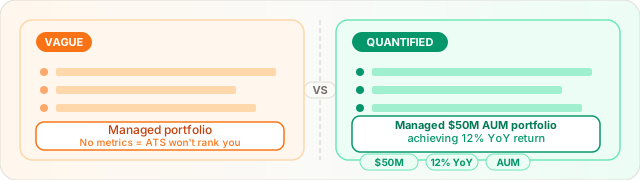
Alpha generation, Sharpe ratio, tracking error, benchmark-relative, long/short, macro overlay, factor exposure, conviction weighting, attribution analysis, drawdown management, AUM (state the amount: “$2B AUM under direct management”).
Risk Management:
VaR, CVaR, stress testing, Monte Carlo simulation, counterparty exposure, Basel III, credit risk, market risk, operational risk, RAROC, model validation, regulatory capital.
Corporate Finance and FP&A:
Three-statement modeling, variance analysis, rolling forecast, zero-based budgeting, cost of capital, WACC, NPV, IRR, scenario analysis, board reporting, investor relations.
Audit and Compliance:
SOX 302/404, internal controls, PCAOB, GAAP, IFRS, substantive testing, management override, audit trail, AML, BSA, KYC, FinCEN, FINRA 2010, Reg SHO.
Include the specific versions or frameworks where they exist. “SOX 404(b)” is more specific than “SOX compliance” and tells an ATS reviewer whether you have worked with external auditor requirements or only management assessment.
How to Format Dollar Figures and Deal Sizes
Finance resumes live and die by quantification, but the format matters for ATS parsing and readability.
Do not write: “$1,247,832 in cost savings.” Write: ”~$1.2M in annual cost savings.”
Do not write: “$3,000,000,000 AUM.” Write: “$3B AUM.”
The abbreviated format is what finance professionals actually use. It is also what ATS parsers trained on finance documents expect. Spelled-out numbers parse correctly but look amateurish; formatted numbers parse correctly and communicate fluency with industry conventions.
For deal sizes in investment banking or PE, include the transaction value: “Advised on $450M acquisition of a specialty chemicals company by a PE sponsor.” This gives the ATS a deal-size signal and gives the human reviewer context about the tier of work you have done.
The Education Section for Finance Roles
Finance, more than most fields, uses university prestige and GPA as screening signals at the junior level. Bulge bracket banks and top-tier consulting firms have historically screened by school tier, and some ATS configurations reflect this.
For analysts and associates within 5 years of graduation:
- Include your GPA if it is 3.5 or above. If your major GPA differs significantly from your cumulative GPA, list both: “3.4 GPA overall, 3.8 GPA in Finance coursework.”
- List relevant coursework: Financial Statement Analysis, Derivatives, Fixed Income, Econometrics, Corporate Finance.
- Include any finance-specific honors: Phi Beta Kappa, Dean’s List, Beta Gamma Sigma.
- For MBA applicants, include GMAT or GRE score if above the median for target programs (730+ GMAT for top programs).
For mid-career professionals (10+ years):
GPA is irrelevant. The education section should be three lines: degree, institution, year. Your track record speaks.
Formatting Decisions for Finance Resumes
Finance ATS systems tend to be conservative. Workday, Taleo, and iCIMS dominate enterprise financial services hiring, and all three handle standard formatting well.
Single-column layout. No tables for your experience section. No graphics. No sidebar with skills ratings. These conventions exist in finance for a reason: finance hiring managers read dozens of resumes, and deviation from the standard format registers as an attention signal for the wrong reasons.
Use reverse chronological order. Finance hiring is tenure-sensitive, and the ATS calculates your years of experience at each level. Functional or hybrid formats obscure this information and produce lower scores.
Name your most recent position prominently. In ATS scoring for finance roles, your current title, firm name, and the prestige signal attached to that firm all influence your score. A Morgan Stanley associate applying to a comparable Lazard role carries a different score than an analyst at a regional advisory firm.
Section Label Conventions
Use “Professional Experience” or “Work Experience,” not “Career History” or “Where I’ve Worked.”
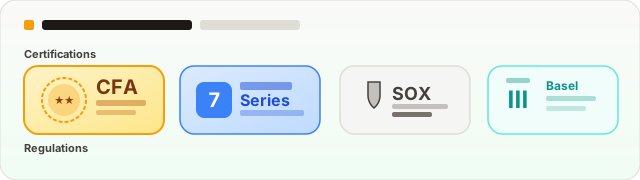
Use “Certifications & Licenses” as a standalone section. Do not fold certifications into your skills list; finance ATS systems weight certification data differently when it appears in a dedicated section.
Use “Education” not “Academic Background.”
A common mistake in finance resumes: combining skills and certifications into one long list. Separate them. Your skills list should contain tools and competencies (Bloomberg, Excel modeling, Python, SQL, Tableau). Your certifications section should contain credentials (CFA, CPA, FINRA licenses, FRM). Mixing them reduces the weighted score for each.
Compliance-Specific Formatting
If you work in compliance or regulatory affairs, your resume needs to be precise about which regulations you have experience with. Listing “regulatory compliance” without specifics does not score well.
Be specific: “FINRA Rule 2010 (Standards of Commercial Honor),” “SEC Rule 17a-4 (record-keeping),” “Basel III Pillar 2 requirements,” “Dodd-Frank Title VII (swaps reporting).” The specificity tells the ATS what you have actually done, and it tells a compliance hiring manager that you know the rule numbers, not just the categories.
ATS systems at financial regulators (SEC, FINRA, OCC, FDIC) and at firms with large compliance functions often include specific rule and regulation names in their screening criteria. Your resume needs to match those strings.
Key takeaways
✓ Certifications with issuing body — write “Chartered Financial Analyst (CFA), CFA Institute” so both the acronym and authority are parseable
✓ Tool specificity — “Bloomberg Terminal (BLP)” scores; “Bloomberg” alone does not reliably match
✓ Role-level vocabulary — Associate, VP, and Director levels use distinct keyword clusters; mismatch reduces your score
✓ Separate credentials from skills — certifications in a dedicated section are weighted differently than skills mixed into one list
✓ Dollar figures in abbreviated form — write “$3B AUM” and “$450M acquisition,” not spelled-out numbers
A finance resume that is both ATS-optimized and genuinely reflective of your experience is not hard to build - but it requires knowing which specific terms the systems are looking for. Run your resume through ATS CV Checker against the specific job description to see which finance-specific keywords you are missing before you submit.