Tailoring a resume for each job requires changing only 5 elements: the headline job title, the first 2 sentences of your summary, the skills section, 2 to 3 experience bullets, and keyword phrasing throughout. The rest of your core experience, education, and structure stays the same. Done systematically, this takes under 15 minutes per application and meaningfully improves both your ATS match score and recruiter response rate.
Tailoring a resume for each job requires changing only five elements - the headline job title, the first two sentences of your summary, the skills section, two or three experience bullets, and keyword phrasing throughout - while leaving your core experience, education, and structure untouched. Done systematically, this takes under 15 minutes per application and meaningfully improves both your ATS match score and recruiter response rate.
Most job seekers approach resume tailoring as an all-or-nothing choice: either send the same generic resume to every job, or spend two hours rewriting from scratch for each application. Both approaches are wrong. The generic resume underperforms in competitive markets. The full rewrite is unsustainable.
ATS match scores are calculated by comparing your resume directly against the job description. A software engineer applying for three different roles may be describing the same underlying experience, but each posting uses different terminology: “distributed systems,” “large-scale infrastructure,” and “cloud-native architecture” may all describe the same skill. A tailored resume reflects the language of each posting. A generic resume picks one formulation and leaves the rest to chance.
There is a middle path that takes roughly fifteen minutes per application and meaningfully improves your ATS score and recruiter response rate without requiring you to rebuild your resume from the ground up.
Why Tailoring Actually Matters
The data on tailored versus generic applications is consistent: response rates improve significantly when resume language is aligned with the specific job description.
The mechanism is straightforward. ATS systems and AI scoring tools compare your resume against the job description to calculate a match score. For a full explanation of how this scoring works, see how ATS systems evaluate resumes in 2026. This score is often the primary filter - recruiters may only see candidates above a certain threshold. If your resume does not use the terminology, skill names, and role-specific language in the job description, it scores lower even when your actual qualifications are strong.
A software engineer applying for roles across three different companies might be describing essentially the same experience, but the job descriptions use different terminology: one says “distributed systems,” another says “large-scale infrastructure,” a third says “cloud-native architecture.” A tailored resume reflects back the language of each specific posting. A generic resume picks one formulation and leaves the others to chance.
Beyond ATS matching, recruiters reading your resume for the first time do the same thing subconsciously - they scan for the terms they just read in the job description. When those terms appear in your resume, the match feels immediate. When they do not, the recruiter has to do more interpretive work, and some of them will not bother.
What NOT to Tailor
Before getting into what to change, be clear on what to leave alone.
Your core experience entries. The substance of what you actually did at each company - your responsibilities, the scale you worked at, the outcomes you drove - should not change. Do not invent experience you do not have, do not inflate scope, do not add metrics that are not real. This is your professional record.
Your education section. Degrees, institutions, graduation years, and relevant coursework do not change per application.
Your overall structure and formatting. Do not restructure your resume for each job. Pick a format that works and keep it. Structural consistency also makes it easier to compare versions and track changes.
Your actual achievement statements. The specific, quantified bullets that describe what you accomplished are your strongest assets. You can swap some of them to emphasize different aspects of your experience, but do not water them down or genericize them in the name of matching language.
The 5 Elements to Tailor
These are the specific components where targeted changes have the highest impact with the least effort.
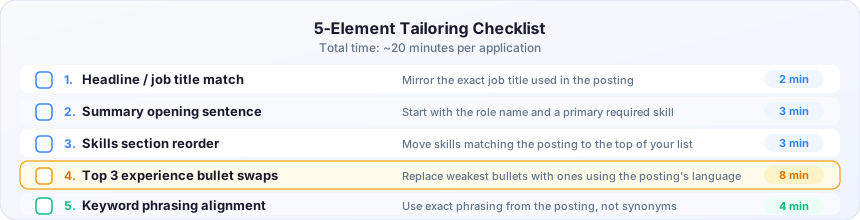
1. Job Title in Your Summary or Headline
Many resumes include either a job title or a professional headline near the top, above the summary paragraph. This is the first thing both ATS and human readers see.
Mirror the exact job title from the job description. If the posting says “Senior Product Manager” and your headline says “Product Lead,” change it to “Senior Product Manager” for this application. If the posting says “Staff Software Engineer” and yours says “Principal Engineer,” adjust accordingly.
This is not misrepresentation - you are applying for the role and representing yourself as a candidate for it. What it does is immediately signal alignment to the ATS match algorithm and to the recruiter’s pattern-matching eye.
2. The First Two Sentences of Your Summary
The professional summary at the top of your resume is the highest-impact real estate for tailoring because it is read first and sets the frame for everything that follows.
Write a version for each application that directly addresses the role’s core requirement as stated in the job description. If the JD emphasizes “building 0-to-1 products in ambiguous environments,” your summary should reflect experience doing exactly that. If the JD emphasizes “scaling existing products across international markets,” your summary should lead with your experience doing that instead.
You are not fabricating different professional identities - you are choosing which true aspects of your experience to foreground. Most experienced professionals have genuinely done several different things and can honestly emphasize different dimensions depending on what each role requires.
3. Skills Section: Reorder and Fill Gaps
Most skills sections are either alphabetical or added to chronologically (newest skills at the bottom). Neither ordering is optimal for matching.
For each application, reorder your skills section so that the skills most prominent in the job description appear first. The skills section guide explains how to structure the section itself for maximum ATS extraction. The skills section guide explains how to structure the section itself for maximum ATS extraction. ATS systems scan left-to-right and top-to-bottom, and early placement of high-priority keywords increases match weighting.
Also: compare your skills list to the job description and identify any genuine skills you have that you have not listed. It is common to have skills that are obvious to you but not written down anywhere on your resume. If you have experience with a tool or methodology the JD requires, and you actually have that experience, add it.
Do not add skills you do not have. This will surface immediately in a technical screen or interview and is worse than not having the skill at all.
4. Swap 2–3 Bullet Points in Your Most Recent Role
Your most recent role receives the most scrutiny. It also has the most tailoring potential.
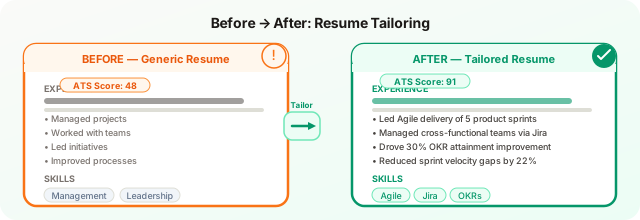
Most people have more accomplishments in their most recent role than can fit on a resume. The selection you include should reflect the priorities of the job you are applying for, not just the things you happened to write down first.
If you are applying for a role that emphasizes cross-functional collaboration and your resume currently leads with technical accomplishments, swap in one or two bullets that describe your work with product, design, or business stakeholders. If you are applying for a role that emphasizes revenue impact and your resume currently emphasizes process improvement, find the bullet that shows financial or commercial outcomes and move it up.
This kind of targeted swap takes five minutes once you know your material well and understand what the role requires.
5. Add Missing Keywords Naturally
After completing the above steps, do a final pass comparing the job description to your updated resume. For a structured method to identify which terms to target, see the ATS keywords guide. Look for high-frequency terms - particularly technical skills, methodologies, industry terminology, and certifications - that appear in the JD but are absent from your resume.
If you have genuine experience with any of these, add them where they fit naturally. Do not stuff keywords into a list at the bottom of the page. Work them into the context of actual experience descriptions.
“Managed vendor relationships and contract negotiations” becomes “Managed vendor relationships, contract negotiations, and SLA compliance for a portfolio of cloud infrastructure contracts” if the JD specifically mentions SLA management and that is something you actually did.
The 15-Minute Tailoring Workflow
This workflow assumes you have a solid master resume to work from (see the next section if you do not).
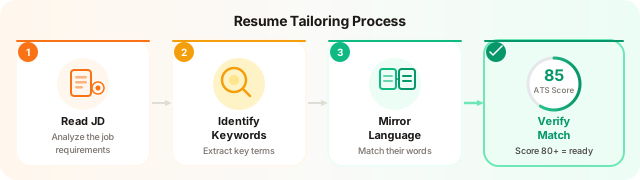
Minutes 1–5: Read the JD and highlight 10 key terms. Read the full job description once for understanding. Then read it again and highlight: the three to five required skills mentioned most frequently, two to three phrases that describe what the role is responsible for, and any specific tools, methodologies, or certifications listed as required or preferred.
Minutes 5–8: Compare against your current resume. Scan your resume against your highlighted terms. Mark any gaps: key terms missing from your resume that you actually have experience with.
Minutes 8–13: Update summary and skills. Rewrite the first two sentences of your summary to reflect the specific role. Reorder your skills section with JD-priority skills first. Add any missing skills you genuinely have.
Minutes 13–18: Swap 1–2 bullets in your top experience entry. Identify the most role-relevant accomplishments from your most recent position and swap in any that are currently absent. Adjust one or two existing bullets to incorporate missing keyword language where it fits accurately.
Minutes 18–20: Run an ATS check. Use a tool to verify your updated resume against the job description. If you want to understand what a match score actually measures, see what your ATS score means. Look for keywords with low match scores that you know you have experience with but may have missed.
The workflow runs slightly over fifteen minutes on complex JDs, but twenty minutes is the realistic ceiling for a well-structured master resume.
The Master Resume Strategy
The foundation that makes fifteen-minute tailoring possible is a master resume - a complete document that contains every significant accomplishment, role description, skill, and project across your career.
Your master resume will be too long to submit anywhere (three to five pages is common for experienced professionals). That is fine. It is not a submission document - it is a source document.
When you tailor for a specific role, you are pulling from this master document and selecting the most relevant content. You are not inventing new content under time pressure.
Build your master resume once, maintain it as you accumulate new experience, and treat it as your professional record. Every tailored submission is a curated selection from it.
When Tailoring Matters Most
Tailoring makes the biggest difference in specific contexts:
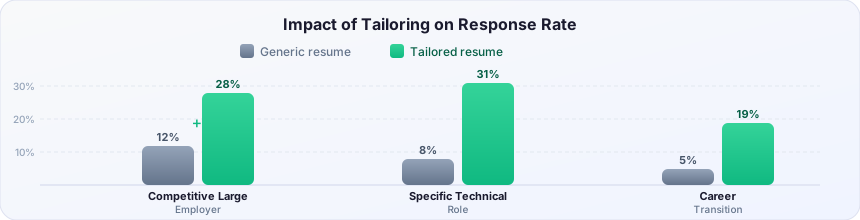
Competitive roles at large employers. When a Fortune 500 company receives 800 applications for one role, ATS filtering is doing heavy lifting. A resume that scores 70% keyword match versus 45% is the difference between being seen and not.
Roles with specific technical requirements. If the JD lists twelve specific tools and you have experience with ten of them, your resume should name all ten. Generic resumes often name six.
Career transitions. When you are moving between industries or functions, the default framing of your experience may not transfer. Targeted reframing of your accomplishments in the language of the new domain makes a significant difference.
Tailoring matters less for roles at small companies where a human reads every resume, for referral applications where a hiring manager already knows your background, and for very senior roles where reputation and network carry more weight than resume mechanics.
The 2–3 Base Version Approach
If you apply across multiple industries or functions - say, both startup and enterprise roles, or both engineering management and technical individual contributor roles - it is worth maintaining two or three base versions of your resume rather than one.
Each base version represents a meaningfully different positioning:
- A version emphasizing leadership, strategy, and organizational impact for management roles
- A version emphasizing technical depth, system design, and hands-on implementation for IC roles
- A version emphasizing cross-functional work and stakeholder management for roles at the intersection of business and technology
Each base version gets the same fifteen-minute tailoring treatment per specific application. A job application tracker helps you manage which version you sent where and measure which tailoring approaches produce the best response rates. The base versions save you from repositioning yourself from scratch every time you cross a significant role-type boundary.
Using ATS CV Checker in the Workflow
The verification step at the end of the tailoring workflow - confirming your resume actually matches the JD - is where ATS CV Checker fits in. Paste your tailored resume and the job description, and the tool identifies which keywords from the JD are missing or underrepresented in your resume.
This catches the gaps you missed during your own review. It is faster and more systematic than manually comparing two documents. It also surfaces cases where you have the experience but used different terminology - a common problem that keyword matching exposes and that you can fix in two minutes once you know it is there.
The combination of a strong master resume, a consistent fifteen-minute tailoring process, and an ATS verification step covers the mechanics. Once you are ready to submit, the Application Autofill feature handles the repetitive form-filling so you can move on to the next application faster. The substance - your actual experience and accomplishments - is what no process can manufacture.
Key takeaways
✓ Five elements to change — job title in headline, first two summary sentences, skills section order, two to three bullet swaps, and keyword phrasing throughout
✓ Master resume as source — maintain a complete multi-page document and pull from it rather than rewriting under time pressure for each application
✓ Terminology matters — the same skill described three different ways across three postings requires three different wordings; ATS matches exact language, not intent
✓ Verify before submitting — run an ATS check after tailoring to catch gaps between your updated resume and the job description’s actual keyword profile