An ATS match score measures keyword presence, section weighting, contextual validation, title-level matching, and years of experience. It does not measure your ability to do the job. Candidates scoring below 40% in major platforms get reviewed by a human less than 3% of the time, according to a 2024 analysis of 10,000 applications. A 72% score in Greenhouse is not comparable to 72% in Taleo because each platform weights factors differently.
Candidates scoring below 40% in major ATS platforms get reviewed by a human less than 3% of the time, according to a 2024 analysis of 10,000 applications. An ATS match score measures keyword presence, section weighting, contextual validation, title-level matching, and years of experience. It does not measure your ability to do the job. A 72% in one system is not comparable to 72% in another because each platform weights these factors differently. The practical goal is a score high enough to reach human review, not the highest score in the pool.
ATS score percentages get thrown around as if they are universal, objective measurements. They are not. An 80% match in Greenhouse means something different from an 80% match in Taleo or a 72% in a third-party tool like ATS CV Checker. Understanding what these scores actually represent - and what drives them - is more useful than chasing a specific number.
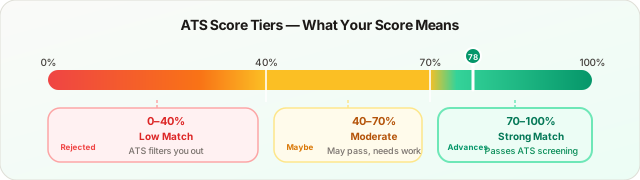
What an ATS Score Is Actually Measuring
When an ATS compares your resume to a job description and produces a percentage, it is typically measuring some combination of:
Keyword presence: What percentage of the skills, tools, and qualifications in the job description appear in your resume? If the JD mentions 20 distinct required skills and your resume contains 14 of them, your coverage rate is 70%.
Keyword context: Not just whether a term appears, but whether it appears in a way that indicates genuine competency. “Managed Salesforce configuration and user administration” scores higher for “Salesforce” than “familiar with Salesforce.”
Section weighting: Keywords in your summary and skills section score higher than keywords buried in the third bullet point of your oldest job. The same keyword in different positions produces different contributions to your total score.
Title and level matching: How well does your most recent title match the target role? Applying for “Data Scientist” when your most recent title is “Data Analyst” creates a level gap that reduces your title-match component.
Experience calculation: Does your verifiable experience history (calculated from your dates) meet the minimum years required by the job description?
Different ATS systems weight these factors differently. This is why the same resume scores differently in different tools - not because any tool is wrong, but because they are measuring the same underlying factors with different weights.
Candidates scoring below 40% in major ATS platforms get reviewed by a human less than 3% of the time, according to a 2024 analysis of 10,000 applications. The practical goal is not the highest score in the pool. It is crossing the threshold where recruiters can see your application at all, which in most systems sits between 60% and 70%.
What the Score Does Not Measure
A score does not measure:
Your actual competence - an ATS has no way to assess whether you can actually do the work
The quality of your writing - keyword density matters; sentence quality is invisible to the scoring engine
Your cultural fit - no ATS scores for this
Reference quality or interview performance - the score is a pre-screen, nothing more
Whether you are the best candidate - you could score 95% and still not get the role; you could score 55% and get hired if a recruiter reads your resume directly
Understanding these limits is important because candidates sometimes optimize so aggressively for ATS scores that they produce documents that score well but read poorly to the humans who make hiring decisions. The goal is a score that gets you to the human review stage - not a score that is the highest in the system.
Typical Score Thresholds in Practice
Most recruiting teams set score thresholds below which candidates are automatically filtered from recruiter review. Based on how ATS systems are typically configured:
Below 40%: Unlikely to advance unless the recruiter manually reviews the filtered pool (which happens, but not consistently)
40-60%: Borderline. May advance if the position has a small applicant pool or if a recruiter is manually reviewing. Many companies set their filter cutoff here.
60-75%: Competitive. Will be surfaced for recruiter review at most companies. Whether you advance from here depends on how your profile compares to other candidates who scored in a similar range.
75%+: Strong candidate by ATS standards. Will typically appear in the recruiter’s primary review queue. Human judgment takes over from here.
These thresholds are not universal - highly specialized roles with few applicants may have no automatic filter. Roles with thousands of applicants may have filters at 70%+. But the general pattern holds: getting above 65-70% is where your application shifts from filtered to visible, and targeted optimization tactics can help you clear that threshold.
The Actions That Actually Move Your Score
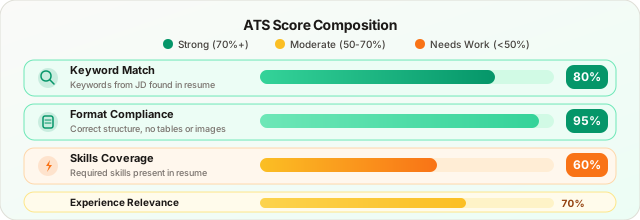
Score improvements come from specific, targeted changes. Here is what has measurable impact and what does not.
High Impact: Adding Missing Required Skills
If the job description lists a required skill you have but did not include on your resume, adding it typically produces the largest score improvement. Every missing required skill is a scoring gap that cannot be compensated for by doing other things well.
How to find these gaps: extract the required skills from the job description, search your resume for each one, and add any you possess but did not list.
Expected impact: Each missing required skill you add moves your score by 2-5 points depending on how heavily that skill is weighted in the JD.
High Impact: Elevating Keywords to High-Weight Sections
If a critical keyword appears only in a bullet point from 2019, its scoring contribution is lower than if it also appears in your summary or skills section. Moving an important keyword into a higher-weight section improves your score without adding new content.
Expected impact: Elevating the top 3-5 missing keywords into your summary or skills section typically moves scores by 5-12 points.
Medium Impact: Adding Context to Existing Keywords
Changing “used Tableau” to “built executive dashboards using Tableau to visualize $240M operating budget variances” does not significantly change your ATS keyword score - “Tableau” is present in both versions. But it improves how AI-augmented screening systems evaluate the depth of your Tableau experience, which affects the AI-generated candidate summary that recruiters see.
Expected impact: Marginal for raw ATS scores, meaningful for AI-augmented screening.
Medium Impact: Matching Exact Phrasing
If the JD says “financial modeling” and your resume says “financial models,” the exact match score for that term may be lower depending on the ATS’s stemming configuration. Some systems treat these as equivalent; others do not. Matching exact phrasing is a low-cost change with inconsistent impact.
When it matters most: In older ATS systems (older Taleo, basic ATS products) with less sophisticated synonym handling. In modern platforms (Greenhouse, Workday 2024+), stemming and semantic matching reduce the impact of exact phrasing.
Low Impact: Repeating Keywords Already Present
Adding a fourth mention of a keyword that already appears three times does not move your score. The keyword is already counted. Additional repetitions do not add score value and risk creating a stuffed appearance for human readers.
Low Impact: Reformatting Without Adding Content
Changing your layout, font, or section organization does not affect your ATS keyword score unless the reformatting improves parsing (which matters if your current formatting has parsing errors). Format changes matter only if they fix a structural problem.
Why Your Score Changes Between Applications
The same resume scores differently against different job descriptions, and this is working correctly. ATS scoring is relative to a specific JD, not absolute. Your resume’s score reflects how well it matches this particular description, not how good your resume is in some universal sense.
A resume optimized for a senior marketing manager role might score 80% against one senior marketing manager posting and 52% against another. The difference is in the specific tools, methodologies, and qualifications the two postings emphasize. This is why tailoring your resume for each application matters more than perfecting one version.
The most useful way to think about ATS scores: they are a diagnostic tool. A low score tells you which specific keywords are missing from your current resume relative to this specific role. Address those gaps, recheck your score, and you will see what changed and what to work on further.
What To Do When You Cannot Improve Your Score Further
Sometimes you reach a point where you cannot improve your score without fabricating experience you do not have. The required qualifications section lists skills you genuinely do not possess. Your score is stuck at 55-60%.
At that point, the honest options are:
Apply anyway with a strong cover letter. A compelling cover letter that directly addresses the gap (“I have not used Salesforce directly, but have extensive experience with HubSpot and Dynamics 365, and have managed multiple CRM migrations”) can move a borderline application forward when a recruiter reads it. The cover letter does not affect ATS scoring, but many ATS platforms surface cover letters alongside resume scores.
Consider whether you are targeting the right roles. A consistent pattern of low scores across similar applications suggests your current skill set does not match your target role. This is actionable information: it tells you what to learn or what to emphasize differently.
Pursue networking and referrals. Referred candidates often bypass automated ATS screening or get placed in priority review queues regardless of score. A referral from a company employee can move a 55% match into the human review queue where a 90% match might be screened out.
Key takeaways
✓ Scores are JD-relative — the same resume scores differently against different job descriptions; a low score tells you which specific keywords are missing for this role
✓ Threshold, not maximum — the goal is crossing 60-70% to reach human review, not achieving the highest score in the applicant pool
✓ Highest impact fix — adding missing required skills you genuinely have typically moves your score more than any other single change
✓ Keyword placement matters — moving a critical term into your summary or skills section improves its scoring contribution even if it already appeared in an older bullet
✓ Referrals bypass filters — referred candidates often skip automated scoring entirely, making networking a practical alternative when score improvement has a ceiling
ATS scores are a starting point, not a ceiling. The candidates who get interviews are not necessarily the ones who scored highest - they are the ones who got over the threshold and had something compelling to say to the human who read their resume next.