Beating ATS in 2026 means mirroring job posting phrasing exactly, front-loading keywords in your summary and skills section, and spelling out acronyms alongside their abbreviations. A qualified candidate with 10 years of experience still gets rejected when synonyms substitute for exact language, or when formatting corrupts text extraction. Modern AI scoring layers detect keyword stuffing, so every skill claim needs supporting evidence in your experience bullets.
Why does a qualified candidate with 10 years of experience still get rejected by automated screening? Usually because their resume uses synonyms instead of exact job description language, buries keywords in the wrong sections, or relies on formatting that corrupts text extraction. Beating ATS in 2026 means mirroring the job posting’s exact phrasing, front-loading keywords in your summary and skills section, and spelling out acronyms alongside their abbreviations. Modern AI scoring layers detect keyword stuffing, so every skill claim needs supporting evidence in your experience bullets.
Most advice about “beating ATS” is either obvious (“use keywords”) or outdated (“stuff your resume with white text”). What follows is a set of concrete, tested strategies based on how applicant tracking systems actually operate in 2026, including the AI-augmented screening layers that have become standard in enterprise hiring over the past two years.
Some of these tips are foundational and apply regardless of the platform. Others are specific to how modern NLP-based scoring engines and LLM-powered recruiter tools have changed the game. All of them are specific enough to act on today.
1. Mirror Job Description Language, Term by Term
Do not assume semantic equivalence. Even though modern ATS systems have improved their ability to recognize synonyms, the scoring weight for an exact match is still higher than for a semantic near-match. If the job description says “stakeholder management,” your resume should say “stakeholder management,” not “client relations,” not “executive communication,” even if those phrases describe the same capability.
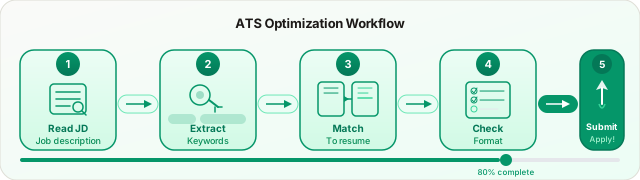
Read the job description and extract every skill, methodology, tool, and competency listed. Then check your resume for coverage. For each gap where you have the experience but not the language, revise a bullet point or your skills section to include the exact phrase. For a complete method for extracting and categorizing keywords from any job description, see the ATS keywords guide. For a complete method for extracting and categorizing keywords from any job description, see the ATS keywords guide.
A qualified candidate with years of relevant experience still gets screened out when their resume uses synonyms instead of the exact phrases from the job description. The ATS does not infer equivalence between “client relations” and “stakeholder management,” even when the work was identical. Exact language matching, not just relevant experience, is what determines whether your application reaches a human.
2. Prioritize the Top Third of Your Resume
ATS scoring engines weight content by position. Content in your summary and skills sections, which appear near the top, contributes more to your match score than content at the bottom of your third job listing. This is not speculation; it mirrors how early parsers were trained and has been preserved in modern architectures.
Your most important keywords should appear at least once in your summary and once in your skills section, before they appear in your experience bullets. Do not save all the relevant language for the body of your experience entries.
3. Build a Targeted Skills Section for Every Application
A static skills section that you never update is a missed scoring opportunity. For each application, compare your skills section against the required and preferred skills listed in the job description. Add any skills you have but did not list. Remove skills that are irrelevant and consuming space.
This is category management, not fabrication: list only skills you can defend in an interview, and make sure the competencies that matter for this specific role are explicitly named in a section the ATS indexes with high weight.
4. Spell Out Acronyms Once, Then Use Both Forms
ATS parsers do not universally treat acronyms and their expansions as equivalent. “ML” and “machine learning” may match to the same skills taxonomy node in Greenhouse but be treated as different strings in iCIMS. The solution is simple: on first mention, write the full term followed by the acronym in parentheses, “machine learning (ML),” so both forms appear in your document’s text. From that point forward, use whichever form appears more naturally in your writing.
This applies to all technical acronyms (SQL, API, NLP, CI/CD), certifications (PMP, CPA, CISSP), and methodology abbreviations (OKRs, KPIs, SaaS).
5. Do Not Keyword-Stuff - Modern AI Detects It
This is the most important contrarian point in this list. Stuffing your skills section with 40 tools you barely know, or repeating the same keyword five times across a single resume, was a detectable tactic even in older ATS systems. In 2026, the AI-augmented recruiter tools that sit on top of ATS platforms flag keyword-dense resumes that do not have supporting context.
If “Kubernetes” appears six times in your resume but none of your bullet points describe what you did with Kubernetes, the AI summary layer will note the mismatch. Human reviewers are also increasingly aware of what a stuffed resume looks like. It signals desperation or dishonesty, and it damages your credibility with the people who review the shortlist.
The correct approach is contextual coverage: every important skill appears in at least one bullet point with enough context to show how you used it. Density follows naturally from genuine experience. For exact guidance on how often to repeat a term by section, see the guide on keyword frequency and density.
6. Use Standard Section Headers Without Exception
Section headers are how ATS systems categorize and file your content. “Professional Experience” works. “Where I’ve Made My Mark” does not. The parser will either categorize the section incorrectly or skip its content entirely.
Every major ATS platform has a whitelist of recognized section labels. “Experience,” “Work Experience,” “Professional Experience,” and “Employment History” are on that whitelist. Creative alternatives are not. The same applies to “Education,” “Skills,” “Certifications,” and “Summary.”
This is not a place for personality or differentiation. Your section headers should be invisible, purely functional labels that let the parser do its job. The ATS resume format guide lists every recognized header label for each section.
7. Align Your Most Recent Job Title to the Target Role
Your current or most recent title carries disproportionate weight in ATS scoring. The system uses it to assess whether you are a legitimate candidate for the role or an outlier. A significant title gap, applying for a Senior Engineer role when your title is Junior Developer, creates a score penalty that even strong keyword coverage may not overcome.
Where your actual title is different from the target title but your responsibilities were equivalent, consider listing your functional title alongside your official title. For example: “Data Analyst (functioning as Senior Data Analyst from 2024).” Be prepared to explain this honestly in interviews, but do not let an arbitrary title from a flat-org-chart startup drag your ATS score down.
8. Write a Summary That Functions as a Dense Signal Layer
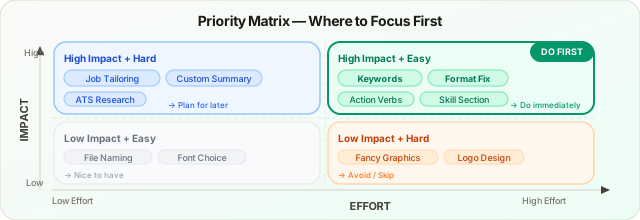
The summary section is the single highest-value real estate on your resume for ATS scoring, and it is underused by most candidates. Four sentences in the summary, written with deliberate keyword choices, can compensate for gaps elsewhere in the document.
Write your summary as if you were answering the question: “What is this person’s professional identity, at what level, with what specialization?” Include your job title equivalent, your years of experience, two or three domain areas, and a specific result or credential. Every noun and skill phrase in that summary should be something that appears in the job description.
This is also where the AI summary layer reads first. A well-written summary gives the AI enough signal to generate a positive candidate summary for the recruiter, which influences how the recruiter approaches your full application.
9. Map Your Skills to O*NET or EMSI Taxonomy Categories
Various major ATS vendors use standardized occupational skills taxonomies to normalize skill extraction. O*NET (the U.S. Department of Labor database) and EMSI Burning Glass are the most widely used. When the ATS extracts “data visualization” from your resume, it maps it to a taxonomy node and checks whether that node is required for the target role.
The practical implication: if the job description uses a specific term that maps to a taxonomy category, use that exact term. Synonyms that map to the same node are fine; terms that do not appear in the taxonomy at all may not register. You can browse O*NET’s occupation profiles at onetonline.org to see how skills are categorized for your target role, and ensure your language aligns.
10. Place Contact Information in the Document Body, Not in Headers or Footers
This is a technical error that eliminates a significant percentage of well-qualified candidates without them ever knowing. Many resume templates, particularly those from Microsoft Word, Google Docs, and third-party template sites, place the candidate’s name and contact information in the document’s header section, formatted with header styles.
Most ATS parsers extract body text only. Your header is not parsed. Your contact information does not exist in the ATS database. Follow-up is impossible; you are simply a match score attached to no contact details.
Fix: use regular paragraph text at the top of your document body for all contact information. It will look identical to a human reader. To a parser, it makes the difference between being contactable and invisible.
11. Address Employment Gaps Briefly and Directly
ATS systems calculate your years of experience and skills tenure from your dates. Unexplained gaps of more than six months will not, by themselves, trigger a disqualification in most systems, but they reduce your calculated years of experience and may flag your profile for additional scrutiny in AI summary tools.
If you have a significant gap for parental leave, health reasons, caregiving, or deliberate career transition, note it briefly in the job entry itself: “(Career break: Jan 2024 – Aug 2024, family caregiving).” This context prevents the AI from flagging the gap as a potential red flag and gives human reviewers the information they need without asking for it.
12. Test Your Resume as Plain Text Before Every Submission
Before submitting any application, paste your resume content into a plain text editor, Notepad on Windows or TextEdit in plain text mode on Mac. Read it from top to bottom. If your structure is intact, sections appear in order, dates are next to the right employers, and bullet points read sequentially, your parsing will be reliable.
If the text is scrambled, with content from different columns mixed together, bullets merged, or dates separated from their entries, you have a format issue. Fix it before submitting, not after wondering why you are not getting interviews.
13. Optimize for Ghost Job Reality with a Targeted Approach
A significant percentage of job postings in 2026 are ghost jobs, positions that are posted but not actively filled, or for which hiring has been paused. The ATS still receives applications, and those applications may sit unreviewed for weeks.
The counter-strategy is not to avoid applying to potentially ghost postings (you usually cannot tell), but to prioritize applications where you can verify active intent: recent postings (within 7 days), roles where the recruiter is named and on LinkedIn, positions where someone in your network can confirm the role is live. Spend more time on high-probability applications and less on spray-and-pray submissions to aging postings.
When you do apply broadly, a well-optimized resume that scores well against the job description maximizes your probability of being surfaced in any resume refresh searches the company runs when they do re-activate a posting.
14. Use Contextual Bullets, Not Responsibility Lists
The difference between a responsibility list and a contextual achievement bullet is the difference between telling an ATS you had a job and telling an ATS and a recruiter what you accomplished in that job.
Responsibility list: “Responsible for managing social media accounts and creating content.”
Contextual achievement: “Grew LinkedIn following from 4,200 to 31,000 over 18 months by publishing a weekly long-form analysis series targeting procurement leaders.”
The contextual bullet contains more keywords (LinkedIn, content, procurement), implies a specific methodology, and conveys measurable impact. For ATS scoring, it also contains more potential keyword matches against any job description that involves social media, content strategy, or B2B marketing.
Write every bullet using this structure: action verb + specific what + specific context or scale + outcome or result when available. For a vetted list of action verbs that perform well in ATS scoring, see the dedicated guide.
15. Run Your Resume Through an ATS Simulator Before You Submit
The only way to know how your resume scores against a specific job description is to simulate it. You cannot know this from reading your resume yourself, because you know what you meant to say. You need to see what a parser extracts and what a scoring engine calculates.
ATS CV Checker replicates this process: paste your resume and a job description, and get a match score, keyword gap analysis, and specific recommendations for improving your score. The 15 minutes you spend reviewing and acting on those results before submitting an application is the highest-ROI time investment in your job search. A resume that scores 45% against a job description faces a structural disadvantage that no cover letter can compensate for. A resume at 80% is competitive regardless of what the cover letter says.
Key takeaways
✓ Mirror exact language — copy terminology from the job description directly; assume the ATS does not treat synonyms as equivalent
✓ Front-load keywords — summary and skills sections carry more scoring weight than experience bullets lower on the page
✓ Avoid keyword stuffing — AI-assisted screening tools flag high keyword density without supporting context as a negative signal
✓ Test before submitting — paste your resume into plain text to confirm formatting parses correctly, then run it against the job description for a score
Apply these tips systematically. Before each submission, run through the ATS resume checklist to catch formatting and keyword gaps. When you are ready to submit, one-click form filling through ATS CV Checker’s autofill feature saves you from retyping your details on every Greenhouse, Workday, or Lever form. The difference between a job search that takes four months and one that takes six weeks is often not qualifications, but how well your resume communicates your qualifications to the systems that decide who gets an interview.