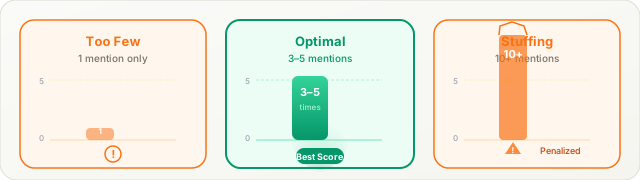
ATS systems measure keyword presence and context, not raw frequency. Most platforms register a genuine competency after 2 to 3 occurrences across different sections. Returns diminish sharply after that threshold. AI-augmented screening now detects keyword stuffing and correlates high density with lower quality scores, so each keyword needs supporting evidence in at least one experience bullet.
You’d expect that repeating a keyword more often would boost your ATS score. SEO works that way, so resumes should too, right? They don’t. ATS systems measure keyword presence across multiple sections - summary, skills, experience bullets - not raw frequency. Most systems need 2 to 3 occurrences to register a genuine competency, and returns diminish after that. Keyword stuffing, meaning many keywords without supporting context, is now detectable by AI-augmented screening and correlates with lower quality scores.
“Use your keywords multiple times.” This advice circulates constantly in job search communities, and it is half right. Understanding the other half - when repetition helps, when it hurts, and what the actual limits are - can significantly improve both your ATS score and your credibility with human reviewers.
What ATS Systems Actually Measure
The term “keyword density” is borrowed from SEO, where it has specific mathematical meaning (keyword count divided by total word count). ATS systems do not use keyword density the same way search engines do.
What most ATS systems measure is keyword presence and context, not frequency alone.
Keyword presence: Does this term appear at least once in this resume? If yes, the ATS notes a match.
Section weighting: Where does the keyword appear? In the summary or skills section (higher weight), in the experience bullets (standard weight), or buried in an education description (lower weight)?
Contextual validation: For AI-augmented ATS systems, does the keyword appear in a context that suggests actual competency? “Managed Python scripts for data pipeline automation” validates Python differently than “familiar with Python” or just “Python” in a list.
Frequency floor: Some systems require a keyword to appear at least two or three times to count it as a genuine competency rather than a passing mention. The floor is typically 2-3 occurrences, not 5-10.
There is no ATS system that rewards you for mentioning “Agile” eight times on your resume. The diminishing returns kick in after the second or third mention. After that point, additional repetition adds no score value and creates visual noise.
Most ATS platforms register a genuine competency after 2 to 3 keyword occurrences across different sections. The benefit of multiple appearances is section weighting, not repetition for its own sake. A keyword in your summary, your skills section, and an experience bullet earns more weight than the same keyword appearing three times inside a single bullet. The placement matters more than the count.
The Case for Multiple Appearances (With Limits)
Appearing in more than one section of your resume does improve your ATS score for that keyword. The benefit is section weighting, not repetition for its own sake.
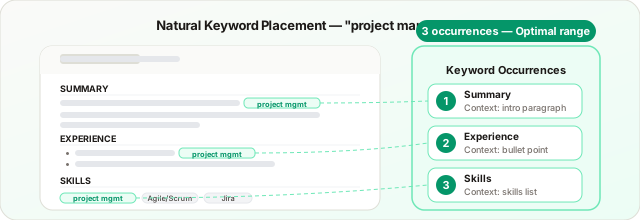
If “stakeholder management” appears once in your experience bullets, you get credit for one weighted mention. If “stakeholder management” appears in your summary, your skills section, and your experience bullets, you get credit at three different weight levels. The score is higher.
This is the legitimate version of the “use keywords multiple times” advice. Not: repeat the exact same phrase over and over. But: make sure your most important keywords appear in multiple sections.
The practical guidance: your top 5-7 keywords for a specific role should appear in:
- Your professional summary
- Your skills section
- At least one bullet point in your experience (ideally your most recent role)
That covers the high-weight sections without creating redundancy. Keywords beyond your top tier need to appear in at least one place - the experience bullets - but do not need to be elevated into the summary or skills section unless they are genuinely central to your candidacy.
What Keyword Stuffing Actually Looks Like
Candidates misunderstand keyword stuffing. It is not simply “using a keyword a lot.” It is the pattern of keywords appearing without supporting context - particularly when AI-augmented screening is involved.
Classic keyword stuffing pattern:
Skills section contains: Python, Machine Learning, Deep Learning, Neural Networks, TensorFlow, PyTorch, NLP, Computer Vision, Reinforcement Learning, Data Science, MLOps, Kubernetes…
Experience bullets contain: “Worked on various ML projects. Contributed to the team’s AI initiatives. Developed Python scripts for data tasks.”
The ATS scores the skills section keywords. The AI screening layer reads the experience bullets and finds nothing to support the claimed skill depth. The AI-generated candidate summary flags this mismatch, and the recruiter sees a candidate who claims broad technical expertise but cannot demonstrate it with specific work examples.
The test: For every term in your skills section, can you point to a specific bullet in your experience section that demonstrates you used that skill? If not, either remove the term from your skills section or add a bullet that provides context.
How Repetition Affects Human Readers
The concern about keyword repetition is not primarily about ATS systems - it is about human reviewers who read shortlisted resumes. Reading the same term five times in one page creates a bad impression.
“Reduced customer churn” in your summary and “developed customer churn reduction strategy” in a bullet and “achieved 23% reduction in customer churn” in another bullet feels repetitive. Three mentions of churn in three different contexts - fine. “Customer churn” in your summary, plus “customer churn” as a standalone skill, plus “customer churn” in two bullets, plus “customer churn” in a project description is too much.
The rule: repeat a keyword only when you are adding new information. Each mention should add context that the previous mention did not provide.
No new information:
- Summary: “Experienced in customer success and churn reduction”
- Skills: “Customer churn reduction”
- Bullet 1: “Reduced customer churn by 18%”
- Bullet 2: “Managed customer churn metrics and reporting”
Each mention adds something:
- Summary: “…customer success leader who reduced churn by 18% at SaaS company serving 2,000 enterprise accounts…”
- Skills: “Customer success, churn analysis, renewal forecasting”
- Bullet: “Built predictive churn model using Mixpanel and BigQuery data, triggering automated outreach 45 days before renewal for at-risk accounts; achieved 31% improvement in renewal rate over 12 months”
The second pattern uses the concept multiple times but each appearance adds specificity: the industry (SaaS), the scale (2,000 enterprise accounts), the tools (Mixpanel, BigQuery), the mechanism (predictive model, automated outreach), and the outcome (31% improvement in renewal rate).
The Right Frequency by Keyword Category
Core role keywords (the 3-5 terms that define the role): Appear in summary + skills section + 2-3 experience bullets. Total mentions: 4-7 across the document. This is appropriate and ATS-beneficial.
Important secondary keywords (relevant tools, methodologies, domain terms): Appear in skills section + 1-2 experience bullets. Total mentions: 2-3. Sufficient for ATS scoring.
Supporting keywords (nice-to-have tools, frameworks, adjacent skills): Appear once, in the skills section or a relevant bullet. Total mentions: 1. Coverage achieved.
Generic terms (communication, leadership, teamwork): If included at all, one mention in a bullet with supporting evidence. Not in the skills section.
Synonym Strategy: Covering Variations Without Stuffing
Different job postings use different terms for the same concept. A keyword strategy that accounts for variation increases your coverage without requiring excessive repetition.
For each important keyword, identify two to three variations and use them across your resume:
- “Machine learning” in summary, “ML” in skills section, “predictive modeling” in a bullet
- “Stakeholder management” in summary, “executive communication” in one bullet, “stakeholder engagement” in another
- “Go-to-market strategy” in summary, “GTM planning” in skills, “market entry strategy” in a bullet
This approach covers synonym variation in the ATS’s matching algorithm and avoids the visual repetition that makes human readers notice you are optimizing for keyword count.
Testing Your Keyword Coverage
Before submitting an application, do this analysis:
- Extract the top required skills and competencies from the job description
- Check your resume for each: does it appear? In which sections? With supporting context?
- For any important term that appears zero times: add it (if you have the skill)
- For any important term that appears only once, in a bullet: consider elevating it to your summary or skills section
- For any term that appears 4+ times without adding new information each time: cut the redundant mentions
Key takeaways
✓ 2 to 3 occurrences is the floor — most ATS systems need at least 2-3 mentions to register a genuine competency, but returns diminish sharply after the second or third appearance
✓ Section weighting beats raw count — a keyword in your summary, skills section, and an experience bullet earns more than the same keyword repeated three times in one location
✓ Each repetition must add information — repeating a term is only useful when each mention adds context (industry, scale, tools, outcome) that the previous mention did not provide
✓ Synonym variation covers more ground — using “machine learning,” “ML,” and “predictive modeling” across different sections covers ATS synonym matching without visual repetition
This analysis takes 10 minutes and tells you more about your actual keyword coverage than any rule about “use each keyword 2-3 times.” Combine this keyword audit with broader ATS optimization tactics for the strongest results. The right number of times is: enough to appear in your high-weight sections, with enough context to validate the claim. That usually means 2-4 appearances for your most important keywords, 1-2 for secondary keywords.
ATS CV Checker runs this analysis automatically against any job description, showing you which keywords are missing, which are present, and whether your coverage is in the right sections of your resume.