Mirroring the job description is necessary but not sufficient. This guide covers the specific vocabulary that ATS systems screen for most frequently across 7 high-demand career categories in 2026: Software Engineering, Product Management, Marketing, Finance, Healthcare, Sales, and Data Science. Each list is drawn from analysis of thousands of job postings. Every term included should reflect experience you can defend in an interview.
Generic keyword advice tells you to “mirror the job description.” That is necessary but insufficient when you are entering a new field, writing your first resume for a role, or trying to understand what hiring managers in a specific industry actually filter on. What follows is drawn from analysis of thousands of job postings across seven high-demand career categories in early 2026 — the terms that ATS systems most frequently screen for, organized by the job titles where they carry the most weight.
This is the actual vocabulary that recruiters type into ATS filters, that LinkedIn Recruiter indexes against, that AI screening tools use to sort candidates into shortlists. Use them as a starting checklist, not a copy-paste template. Every term you include should reflect genuine experience you can defend in an interview.
How to Use These Lists
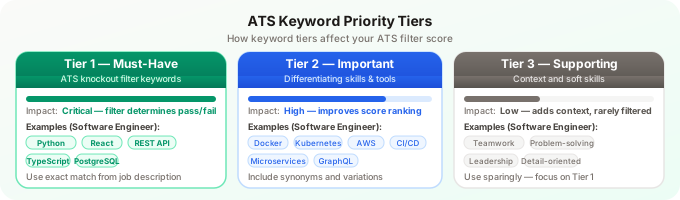
Not all keywords carry equal weight in ATS scoring. Understanding the hierarchy changes how you prioritize.
Tier 1 keywords are the terms that appear in almost every job posting for a given title. Missing these triggers automatic rejection in systems with knockout filters. These are your non-negotiables.
Tier 2 keywords differentiate you within the shortlist. They appear in 40-70% of postings and signal specialization depth. Including three or four relevant Tier 2 terms moves you from “meets minimum requirements” to “strong match.”
Tier 3 keywords are emerging or niche terms that signal you are current with industry trends. They rarely appear in ATS knockout filters but influence AI scoring layers and impress human reviewers.
For each role below, keywords are organized into these tiers. Use these alongside the complete ATS keywords guide to identify gaps. Prioritize Tier 1 coverage first. Add Tier 2 based on your actual skills. Sprinkle Tier 3 where honest.
Software Engineer
The software engineering keyword field has shifted noticeably since 2024. AI-adjacent terms now appear in roughly 60% of backend and full-stack postings, even when the role is not primarily an ML position.
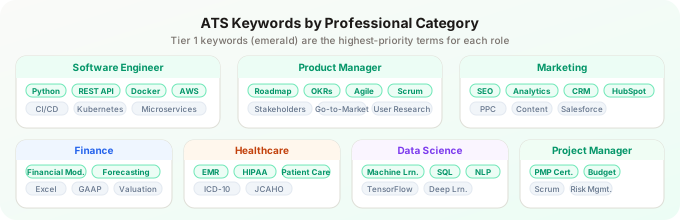
Tier 1 (present in 80%+ of postings): Python, JavaScript, TypeScript, SQL, Git, REST APIs, CI/CD, Agile, unit testing, code review, microservices, cloud (AWS/GCP/Azure)
Tier 2 (40-70% of postings): Docker, Kubernetes, React, Node.js, PostgreSQL, Redis, GraphQL, Terraform, system design, distributed systems, event-driven architecture, observability, monitoring
Tier 3 (emerging, 15-35% of postings): LLM integration, prompt engineering, RAG pipelines, vector databases, AI-assisted development, edge computing, WebAssembly, platform engineering
“CI/CD” catches candidates off guard. Five years ago it was primarily a DevOps term. Now it appears in the vast majority of engineering postings, including mid-level ones. If your resume says “deployment” but not “CI/CD pipeline,” you are losing points.
Not all keywords carry equal weight. Tier 1 terms appear in 80% or more of postings for a given role and function as knockout criteria in many ATS configurations. Missing even one or two of them can trigger automatic rejection before a human sees your application. Tier 2 terms separate strong candidates from borderline ones once initial screening is cleared.
Product Manager
Product management keywords are split between technical fluency terms and business outcome terms. ATS systems at tech companies tend to weight the technical terms more heavily; ATS at traditional enterprises weight the business terms.
Tier 1: Product roadmap, stakeholder management, user research, A/B testing, data-driven decision making, cross-functional collaboration, Agile, Scrum, product strategy, go-to-market (GTM), OKRs, KPIs
Tier 2: SQL, Jira, product analytics, competitive analysis, customer discovery, sprint planning, user stories, wireframing, market research, feature prioritization, PRD (product requirements document), revenue growth
Tier 3: AI product management, LLM product strategy, product-led growth (PLG), jobs-to-be-done (JTBD), outcome-driven innovation, growth experimentation, product operations
“SQL” now appears in roughly half of PM postings at tech companies. PMs are not expected to write production queries — hiring managers use the term as a proxy for analytical self-sufficiency. If you have basic SQL skills, list them. The keyword carries outsized weight relative to the depth of skill expected.
Marketing (Digital Marketing / Growth)
Marketing keywords fragment heavily by specialization. The list below covers the broadest digital marketing and growth marketing postings. If you are targeting a specific channel (SEO, paid media, content), supplement these with channel-specific terms from the relevant job descriptions.
Tier 1: SEO, SEM, Google Analytics, content strategy, email marketing, social media marketing, marketing automation, CRM, conversion rate optimization (CRO), campaign management, lead generation, ROI analysis
Tier 2: HubSpot, Salesforce Marketing Cloud, Google Ads, Meta Ads, Marketo, A/B testing, marketing attribution, customer segmentation, funnel optimization, brand strategy, copywriting, demand generation
Tier 3: AI-powered personalization, generative AI for content, first-party data strategy, privacy-first marketing, zero-click content, community-led growth, product marketing, RevOps alignment
“Marketing attribution” has quietly climbed to Tier 2 because of the measurement chaos created by privacy regulations and cookie deprecation. If you can speak to attribution models beyond last-click, you have a keyword advantage that also happens to reflect genuine strategic value.
Finance and Accounting
Finance keywords are unusually precise. ATS knockout filters in financial services tend to use exact certification names and regulatory framework terms. Synonym matching helps less here than in other fields because compliance language is standardized.
Tier 1: Financial analysis, financial modeling, Excel, budgeting, forecasting, GAAP, variance analysis, P&L management, accounts payable/receivable, reconciliation, month-end close, ERP systems
Tier 2: SAP, Oracle Financials, NetSuite, Hyperion, Power BI, Tableau, SQL, SOX compliance, audit, tax compliance, cash flow management, cost accounting, FP&A (financial planning and analysis)
Tier 3: ESG reporting, AI-assisted forecasting, real-time financial analytics, blockchain accounting, IFRS 17, climate risk disclosure, automated reconciliation
Finance ATS systems are particularly rigid about certification matching — regulatory requirements leave no room for fuzzy matching. Spell out every certification fully and include the abbreviation. “Certified Public Accountant (CPA)” gives you two keyword surfaces. Miss the exact string and some systems will automatically disqualify you.
Healthcare (Clinical and Administrative)
Healthcare ATS systems frequently use certification-based knockout filters that are more aggressive than any other industry. A registered nurse posting might require “BLS” and “ACLS” as hard filters before a human ever sees the application.
Tier 1: Patient care, electronic health records (EHR), HIPAA compliance, clinical documentation, vital signs, patient assessment, care coordination, medical terminology, CPR/BLS certified, interdisciplinary team
Tier 2: Epic Systems, Cerner, medication administration, discharge planning, infection control, quality improvement, patient education, triage, case management, telehealth, ICD-10 coding
Tier 3: AI-assisted diagnostics, remote patient monitoring, health equity, social determinants of health (SDOH), value-based care, population health management, precision medicine
“Electronic health records” is generic. “Epic Systems” or “Cerner Millennium” is what actually matches. Most hospital ATS systems filter on the specific EHR platform they run. Find out which system your target employer uses and name it on your resume.
Sales
Sales keywords bifurcate into activity metrics and methodology terms. Enterprise sales postings lean heavily on methodology (MEDDIC, Challenger, Solution Selling). SMB and SaaS sales postings emphasize activity volume and tooling.
Tier 1: CRM, Salesforce, pipeline management, quota attainment, prospecting, lead qualification, negotiation, closing, account management, revenue growth, B2B sales, business development
Tier 2: HubSpot, Outreach, Gong, MEDDIC, Challenger Sale, consultative selling, solution selling, territory planning, upselling, cross-selling, customer success, sales forecasting, cold outreach
Tier 3: AI-powered sales intelligence, product-led sales, revenue operations (RevOps), signal-based selling, buyer intent data, sales enablement platforms, multi-threading
“Quota attainment” paired with a specific number is more powerful than any other term on this list. “Achieved 118% of quota in FY2025” hits a keyword match and provides the quantitative proof that sales hiring managers care about above all else. Always include your number.
Data Science and Analytics
Data science keywords have shifted significantly as the field has absorbed generative AI. Pure statistical modeling terms have not disappeared, but they now coexist with LLM-related vocabulary in the majority of postings.
Tier 1: Python, SQL, machine learning, statistical analysis, data visualization, Pandas, scikit-learn, Jupyter, A/B testing, data pipelines, ETL, Tableau or Power BI
Tier 2: TensorFlow, PyTorch, Spark, Airflow, dbt, feature engineering, experiment design, deep learning, NLP, time series forecasting, data governance, cloud ML services (SageMaker/Vertex AI)
Tier 3: LLM fine-tuning, RAG architecture, vector embeddings, MLOps, model monitoring, responsible AI, causal inference, synthetic data, real-time inference, LLMOps
Python and SQL appear in over 90% of data science postings. Their absence from a resume is a near-certain knockout. If you primarily use R, still list Python if you have working proficiency — the ATS does not know which language you prefer. It only knows which terms are present.
Cross-Industry Keywords That Appear Everywhere
Certain terms have become so universal across industries that they function as baseline expectations rather than differentiators. Missing them is costly; including them is table stakes.
Universal Tier 1 (present across all seven categories above):
- Cross-functional collaboration
- Data-driven decision making
- Process improvement
- Project management
- Communication (but only when evidenced in a bullet, never as a standalone skill)
The AI overlay: In 2026, approximately 30% of job postings across all categories now include at least one AI-related term. “AI tools,” “AI-assisted workflows,” or “experience with AI/ML” appears even in roles that are not technical. Candidates who can honestly claim they use AI tools in their workflow have an incremental keyword advantage that did not exist 18 months ago.
From Keyword Lists to Resume Strategy
A list of keywords is a tool, not a strategy. The strategy is in how you deploy them.
Start by checking which Tier 1 terms for your target role are already on your resume. Any missing terms where you have genuine experience are immediate scoring opportunities — low effort, high return.
For each Tier 1 term you add, make sure it appears in at least two places: your skills list and one experience bullet that shows context. A keyword in a skills list with no supporting bullet carries less weight than one backed by a concrete example.
Then pick three to five Tier 2 terms that reflect your actual specialization. These move you from “qualified” to “strong match” in ATS ranking. Finally, add one or two Tier 3 terms, but only if you can speak to them substantively in an interview. Claiming emerging skills without substance backfires quickly.
Test your resume against any job description in 60 seconds — ATS CV Checker is a free Chrome extension that does this automatically on every job page you visit.
The Keywords Change. The Method Does Not.
Specific terms on these lists will evolve. Some Tier 3 keywords will graduate to Tier 1 within a year. New tools will emerge and replace current ones. The method — organize by tier, cover multiple sections, back every claim with context — stays the same.
Key takeaways
✓ Tier 1 first — cover all Tier 1 terms for your role before worrying about differentiation keywords; missing these triggers rejection
✓ Two-location rule — each important keyword should appear in your skills section and in at least one experience bullet with context
✓ Python and SQL for data roles — these appear in over 90% of data science postings; their absence is a near-certain knockout
✓ AI terms now universal — roughly 30% of postings across all categories include at least one AI-related term in 2026
✓ Certification exact strings — “Certified Public Accountant (CPA)” gives you two match surfaces; the abbreviation alone may miss some filters
Bookmark this page and check it against specific job descriptions you are targeting — then use resume tailoring strategies to adapt your language to each posting. Your highest-scoring resume lives at the intersection of these industry-wide patterns and the specific language of the posting in front of you.