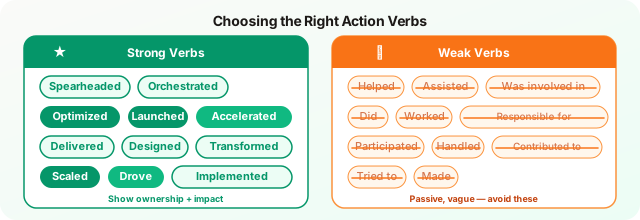
Strong action verbs improve ATS scoring because modern systems extract verb-object pairs as competency signals, distinguishing someone who "architected" a system from someone who "maintained" it. Weak verbs like "responsible for," "helped with," and "worked on" carry near-zero signal weight. Replacing all three types across a resume is typically the highest-return edit you can make in under 30 minutes, with measurable score improvements of 5 to 15 points.
Strong action verbs improve both ATS scoring and recruiter perception because modern ATS systems extract verb-object pairs as competency signals - distinguishing someone who “architected” a system from someone who “maintained” it. Weak verbs like “responsible for,” “helped with,” and “worked on” carry near-zero signal. Replacing them with specific, ownership-level verbs is one of the highest-return edits you can make to a resume.
Action verbs are one of the few elements of a resume that simultaneously influence ATS scoring and recruiter perception. They matter for two distinct reasons, and understanding both helps you choose the right verb for each bullet rather than picking from a generic list.
Why Verb Choice Matters to ATS
Modern ATS systems do not just extract nouns (tools, skills, job titles). They extract verb-object pairs as part of semantic skill identification. When you write “Architected a distributed data pipeline handling 50M daily events,” the system identifies not just “data pipeline” as a domain term, but “architected” as a competency signal associated with design-level technical work, distinguishing it from someone who “maintained” or “supported” the same system. For a full picture of how this fits into ATS keyword strategy, see the dedicated guide.
This is meaningful in practice. Skills taxonomies used by platforms like Workday and iCIMS increasingly weight candidate competency level based on the action verbs surrounding skill mentions. An engineer who “built” a CI/CD pipeline scores differently than one who “used” a CI/CD pipeline, even if both mention the exact same technology.
Verbs are not decorative. They are part of how ATS infers your level of ownership and responsibility for the work you describe.
The Weak Verb Problem
Certain phrases appear on the majority of resumes and carry almost no informational value, to either a parser or a human reader.
Every employee is "responsible for" their job description. The verb tells ATS nothing about what you actually did or what level of ownership you held.
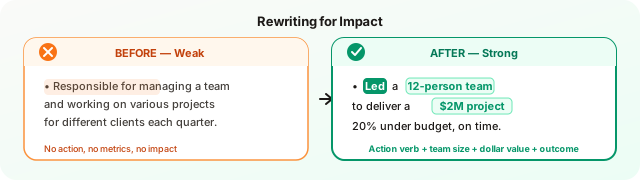
“Responsible for” is the most common offender. It describes a duty, not an action. It says nothing about what you actually did or what resulted from your effort. Every employee is “responsible for” their job description. “Responsible for managing a team of six” tells a recruiter nothing that “Led a team of six engineers through three product launches” does not tell them better.
“Helped with” and “assisted with” signal a supporting role, not ownership. Unless supporting someone else’s work is the specific point you are making, these phrases undercut your contribution. If you co-led something, use “co-led.” If you drove the work, own the verb.
“Worked on” is similarly vague. It could mean you were peripherally involved or you were the primary contributor. The ambiguity does not serve you.
“Managed” is not inherently weak, but it is overused and imprecise. There is a meaningful difference between managing a budget and managing a team and managing a project timeline. If you use “managed,” specify what you managed and what the outcome was.
The Formula for Strong Bullet Points
Strong resume bullets follow a consistent structure:
[Strong Verb] + [Specific What] + [Quantified Result or Context]
Every element earns its place. The verb establishes agency. The “what” establishes scope. The result establishes impact.
Weak: Responsible for email marketing campaigns.
Stronger: Managed quarterly email marketing campaigns targeting 120,000 subscribers.
Strongest: Rebuilt email marketing program for 120,000-subscriber list, increasing open rates from 18% to 31% and driving $240K in attributed pipeline over six months.
The jump from “managed” to “rebuilt” changes the ATS interpretation of your ownership level. The specific numbers give the recruiter something concrete to evaluate.
Categorized Verb Reference
Leadership and Management
Use when describing people leadership, organizational decisions, or team-building work.
Led, Directed, Supervised, Oversaw - Establish clear accountability for a team or function. Use when you had direct reports or decision authority.
Built (a team or organization) - Signals that you grew something from scratch or significantly. “Built a 22-person customer success team from the ground up” is a complete signal.
Mentored, Coached, Developed - Distinguish developmental leadership from supervisory leadership. More appropriate for senior IC roles or management roles where people growth was a specific focus.
Recruited, Hired, Staffed - Relevant when talent acquisition was a significant part of your scope.
Championed - Signals internal advocacy and influence without direct authority. Use carefully, since it implies you drove something through organizational resistance, which is meaningful if accurate.
Scaled - Specific to growth contexts. “Scaled the engineering organization from 8 to 45 engineers over 18 months” tells a complete story.
Analysis and Problem-Solving
Use when the core of your contribution was diagnostic, investigative, or evaluative.
Analyzed, Evaluated, Assessed - Foundational analysis verbs. Prefer more specific alternatives where the analysis had a defined output.
Diagnosed - Strong for technical, operational, or organizational problem-solving. Implies you identified a root cause, not just a symptom.
Investigated - Appropriate for audit, compliance, research, and legal contexts.
Identified - Works well when discovery was the key contribution: “Identified $3.2M in unrealized cost savings across vendor contracts.”
Audited - Finance, compliance, and operational contexts. Specific and credible.
Resolved, Troubleshot - Engineering, operations, and support contexts. “Resolved a recurring database deadlock issue that had caused four production outages” is a complete statement.
Streamlined - Appropriate when you simplified a process. Avoid using it without specifying what was simplified and the outcome.
Building and Creating
Use when you originated, designed, or brought something into existence.
Developed, Built, Created - Foundational creation verbs. Distinguish between developing a product (scope: end-to-end) and developing a feature (scope: component).
Architected, Engineered, Designed - Carry stronger seniority signals than “built” or “created.” Use when you made structural decisions, not just implementation decisions.
Launched - Implies a market or operational debut. Appropriate for products, campaigns, programs, and services. “Launched” implies a defined start date and a handoff to operational status.
Established - Appropriate for programs, processes, and functions that previously did not exist. “Established the company’s first dedicated customer research practice” is a founding signal.
Implemented - Appropriate for deploying something designed elsewhere. Honest about the level of ownership: you executed, you did not originate.
Deployed - Technical and operational contexts. Implies a transition from development or staging to production or live status.
Growth and Revenue
Use in sales, marketing, business development, and any role with commercial accountability.
Generated, Drove - Direct revenue connection. “Generated $1.8M in new ARR from mid-market accounts” is a complete sales bullet.
Grew, Increased, Expanded - Appropriate for metrics that improved under your ownership. Always attach a percentage or absolute number.
Accelerated - Implies a speed dimension: you made something happen faster than baseline. Use when timeline compression was the specific value you added.
Acquired - Business development and sales contexts. Customer acquisition, partner acquisition, market acquisition.
Converted - Sales and marketing contexts. Conversion implies moving a prospect or lead through a funnel stage.
Closed - Sales-specific. “Closed 18 enterprise deals averaging $140K ARR” is a concrete bullet.
Improvement and Optimization
Use when your contribution was making an existing thing work better, faster, or cheaper.
Optimized - The most common improvement verb. Pair with a specific metric: “Optimized database query performance, reducing average page load time from 4.2 to 1.1 seconds.”
Reduced, Cut - Cost reduction, time reduction, error reduction. Always include magnitude.
Automated - High-value in 2026. Implies judgment about what was worth automating and the technical execution to do it. “Automated the weekly reporting pipeline, eliminating 12 hours of manual work per analyst per week.”
Consolidated - Operational or organizational simplification. Vendor consolidation, system consolidation, team structure consolidation.
Standardized - Process maturity signal. Relevant for operations, engineering, and any function where consistency is a quality dimension.
Modernized, Restructured - Transformation contexts. Implies the previous state was inadequate and you made a deliberate shift.
Collaboration and Coordination
Use when cross-functional influence or alignment was the core of your contribution.
Partnered - Implies peer-level collaboration, not a reporting relationship. “Partnered with legal, finance, and product to define the data privacy framework” is accurate for cross-functional project work.
Coordinated - Project and operations contexts. More execution-oriented than “partnered.”
Facilitated - Workshop, training, and meeting contexts. Also used for enabling something that required removing barriers.
Aligned - Organizational contexts. “Aligned five regional teams on a unified go-to-market approach” implies you resolved disagreement or fragmentation.
Communication and Influence
Use when written, verbal, or published output was a significant part of your contribution.
Presented - Board presentations, executive briefings, client presentations, conference talks.
Negotiated - Contracts, partnerships, compensation structures, vendor agreements. Always follow with the outcome.
Authored, Published - Written artifacts: policies, papers, documentation, articles. Stronger than “wrote” because it implies intentional, distributed output.
Trained, Coached, Advised - Knowledge transfer contexts. Distinguish by audience size and formality.
Tense, Variety, and Practical Rules
Tense: Current role uses present tense (“Lead,” “Manage,” “Build”). All past roles use past tense (“Led,” “Managed,” “Built”). This is grammatically correct and expected, not optional.
Variety: Do not start every bullet with the same verb. Six bullets starting with “Led” on a single job entry signals either limited vocabulary or poor editing. Review each job entry and ensure you are using at least three to four distinct verbs.
First position carries the most weight. The first word of each bullet receives the most attention from both ATS parsers and human eyes scanning quickly. Choose the strongest verb you have for first position.
Verbs without numbers are half as powerful. A strong action verb tells the recruiter you did something. A number tells them it mattered. “Increased” requires a percentage. “Reduced” requires a dollar amount or time metric. “Launched” benefits from an outcome measure (adoption rate, revenue, user count). Treat the number as part of the verb phrase, not an optional add-on.
Verbs to avoid entirely: “Responsible for,” “Helped with,” “Worked on,” “Assisted with,” “Participated in,” “Involved in,” “Tasked with.” These describe job duties, not professional agency. They are grammatically passive even when technically active voice. Remove them from your resume entirely.
The goal is not to have the most impressive-sounding verbs. It is to have the most accurate ones: verbs that precisely capture what you actually did, at what level of ownership, with what outcomes. That precision serves both the automated system reading your resume and the person who eventually needs to decide whether to trust you with a role. For how to structure the section that contains these verbs, see the resume skills section guide.
Action verb quick reference:
- Leadership: Led, Built, Scaled, Directed, Championed, Mentored
- Analysis: Diagnosed, Identified, Investigated, Evaluated, Resolved
- Technical: Architected, Engineered, Optimized, Automated, Deployed
- Growth/Sales: Captured, Generated, Closed, Expanded, Drove
- Improvement: Streamlined, Reduced, Eliminated, Accelerated, Improved
- Communication: Presented, Negotiated, Advised, Authored, Facilitated