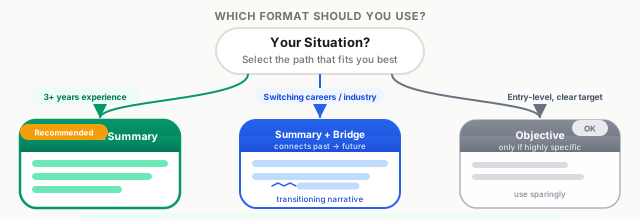
A professional summary outperforms a resume objective in almost every scenario in 2026. Objectives describe what you want. Summaries describe what you offer. Modern ATS platforms with semantic understanding extract job title signals, years of experience, and skill matches from your summary before parsing any other section. The objective format is only appropriate for career changers and new graduates with minimal work history who need to frame a transition explicitly.
Should your resume open with a summary or an objective? In 2026, a professional summary wins in almost every scenario. Objectives describe what you want from an employer. Summaries describe what you bring to them. Modern ATS platforms with semantic understanding extract job title signals, years of experience, and skill matches from your summary before parsing any other section. The objective format is only appropriate for career changers or new graduates with minimal experience.
The top of your resume is the most contested real estate on the page. Before a recruiter reads your first job title, before an ATS parses your skills section, there is a block of text, two to five sentences, that sets the tone for everything that follows. Whether that block is a summary, an objective, or nothing at all is a decision worth making deliberately.
Modern ATS platforms with semantic understanding extract a candidate profile from the summary before parsing any other section. Your job title, years of experience, and core skills are read first from this block. A weak or generic summary does not just fail to help: it can set an inaccurate candidate profile that the rest of your resume then struggles to correct.
The Resume Objective Is Effectively Dead
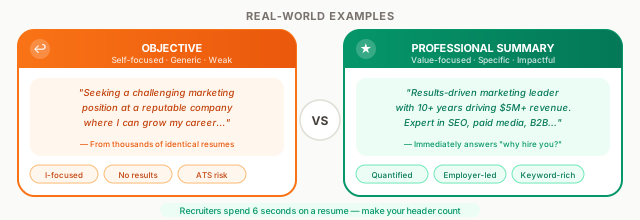
The objective statement was the standard for decades. It told employers what you were looking for: “Seeking a challenging position in a growth-oriented organization where I can apply my skills.” Read enough of those and you understand why hiring managers stopped paying attention to them.
The fundamental problem with the objective is structural: it tells the employer what you want from them, not what you bring to them. In a competitive job market, that framing is backwards.
There are exactly two scenarios where an objective still makes sense:
- Career changers who need to explicitly frame a non-linear background. If you spent eight years in nursing and are now applying for healthcare technology sales, an objective can preempt the confusion a recruiter might feel reading your chronology.
- New graduates with minimal experience who have no meaningful professional summary to write. Even here, a targeted objective beats a vague one by a wide margin.
In every other case, a professional summary is the right choice.
Why the Summary Section Matters More Than Ever in 2026
Two things happened over the past few years that elevated the summary from “nice to have” to genuinely consequential.
First, modern ATS platforms, particularly those running on large language models, extract a candidate profile from the resume before parsing individual sections. The summary is the densest source of identity signals on the page. Your title, years of experience, primary domain, and core skills are often most clearly stated there. An ATS with semantic understanding will weight heavily what appears at the top of the document.
Second, recruiter behavior has not changed: the top third of page one gets the most attention. Eye-tracking research consistently shows that experienced recruiters scan the name, title, and opening text before deciding whether to continue. A weak summary is not just a missed opportunity. It can end the review before it starts.
What ATS Systems Extract from Your Summary
Algorithmic screening is not keyword matching anymore, or not only keyword matching. In 2026, most enterprise ATS systems (Workday, Greenhouse, Lever, iCIMS, and their AI overlays) apply some form of semantic extraction to candidate documents. From your summary, they are looking for:
- Job title signal: Does your current or most recent title match the role, or approximate it?
- Years of experience: Can the system infer a career stage? Phrases like “10+ years” or “early-career” are parsed directly; the system also infers from date ranges when explicit statements are absent.
- Skill taxonomy alignment: Do the terms you use map to the skills taxonomy the job posting was built from? Generic terms matter less than specific ones. “Machine learning” is better than “AI.” “React” is better than “front-end frameworks.”
- Industry and domain signals: “B2B SaaS,” “financial services,” “clinical research” - these context signals influence candidate scoring even when they are not explicit job requirements.
None of this means stuffing your summary with keywords. Semantic models are sophisticated enough to recognize keyword padding, and recruiter-facing summaries that read like search queries get discarded. The standard is writing that is specific and accurate, which happens to be keyword-rich when done well.
The Four-Sentence Summary Formula
This structure works across industries and experience levels:
Sentence 1 - Identity: [Role title] with [X years] of experience in [key domain or industry].
Sentence 2 - Expertise: Expertise in [3–4 specific skills or methods], with a focus on [specialty or sector].
Sentence 3 - Achievement: Track record of [quantified result] through [method or approach].
Sentence 4 - Intent (optional for career changers or targeted applications): Seeking [target role type] within [type of organization or industry].
You do not need to use all four sentences if three cover what matters. Sentence four is often unnecessary for candidates applying within their established field - the job application itself expresses intent.
Before and After: Three Examples
Software Engineer
Weak: Results-driven software engineer with a passion for technology and team collaboration. Experienced in multiple programming languages and agile methodologies.
Strong: Backend software engineer with 7 years of experience building distributed systems for fintech and e-commerce platforms. Expertise in Go, Kubernetes, and PostgreSQL, with a focus on high-throughput APIs. Reduced average API response time by 40% at [Company] by redesigning the caching layer, supporting 3× traffic growth without infrastructure cost increases.
Marketing Manager
Weak: Dynamic marketing professional with excellent communication skills and a passion for building brands. Proven ability to work across teams and deliver results.
Strong: B2B marketing manager with 9 years of experience in demand generation and content strategy for SaaS companies. Expertise in HubSpot, SEO-led content programs, and paid LinkedIn campaigns. Generated $4.2M in attributed pipeline in 2024 through an integrated inbound program that reduced cost-per-MQL by 28%.
Accountant
Weak: Detail-oriented accountant seeking a challenging position in a fast-paced environment. Strong knowledge of accounting principles and software.
Strong: CPA with 12 years of experience in financial reporting and audit for mid-market manufacturing companies. Expertise in US GAAP, ASC 842 lease accounting, and NetSuite ERP. Streamlined month-end close from 12 days to 7 days by redesigning reconciliation workflows and implementing automated variance reporting.
Common Summary Mistakes
Vague personality claims: “Results-driven,” “passionate,” “dynamic,” and “detail-oriented” communicate nothing measurable. Every candidate claims these traits. Use the space for specifics.
Responsibilities framed as achievements: “Managed a team of five” is a responsibility. “Managed a team of five that delivered the product roadmap six weeks ahead of schedule” is an achievement. The distinction matters to every human reader and increasingly to semantic ATS parsing.
No keywords from the job description: Your summary should reflect the language of the role you are applying to. This does not mean copying the posting verbatim - it means that if the job asks for “stakeholder management” and your summary says “cross-functional coordination,” you are leaving a match on the table.
Length beyond five sentences: A summary longer than five sentences competes with the rest of the resume for attention it has not earned yet. Keep it tight.
How Semantic ATS in 2026 Reads Summaries Differently
Earlier generations of ATS systems parsed resumes as structured data, looking for keywords in defined fields. Modern systems apply transformer-based language models that understand context. This has two practical implications:
First, synonyms matter less. You no longer need to include every possible variant of a skill. “Project management” is understood to relate to “program management,” “delivery management,” and similar terms. The system understands the domain.
Second, context matters more. “Python” in a data engineering summary scores differently than “Python” in a general context, because the surrounding text signals what kind of Python work is being described. Writing a summary that is specific about your domain gives the model more signal to work with.
Summary for Career Changers
If you are changing careers, the summary carries additional weight because your chronology will raise questions. Use it to explicitly acknowledge the transition and frame your transferable value:
Structure for career changers: Former [previous role] transitioning to [target field], bringing [X years] of experience in [transferable domain]. Expertise in [skills that transfer]. [Quantified achievement in the new direction, or a relevant project]. Now focused on [target role or function] where [what you specifically want to contribute].
The goal is to answer the recruiter’s first question, “why are they applying for this?”, before they have to ask it.
Placement and Length
The summary belongs immediately below your name and contact information, before your experience section. It should be three to five sentences, or roughly 60 to 100 words. It should not be a bulleted list - that format belongs in the skills section. It should read as coherent, professional prose.
Do not label it “Objective.” Label it “Summary,” “Professional Summary,” or simply leave it unlabeled with the text starting directly. Some ATS systems use section headers to categorize content; “Summary” is a widely recognized header value. “Objective” may cause the section to be parsed and weighted differently.
The summary is the first thing read and the last thing most candidates invest time in. Reversing that priority is one of the highest-return improvements you can make to a resume.
Key takeaways
✓ Summary beats objective — objectives describe what you want; summaries describe what you offer, which is what employers need to see first
✓ ATS extracts from summary first — your title, experience level, and domain are profiled from this block before any other section is parsed
✓ Four-sentence formula — identity, expertise, achievement, and optional intent covers all the signals a strong summary needs
✓ Label it correctly — use “Summary” or “Professional Summary” as the header; “Objective” changes how some ATS systems weight and categorize the section