Career changers face a structural ATS disadvantage because their resume vocabulary, job titles, and career patterns don't map to the target field's scoring criteria. The fix is a modified chronological resume with a summary that frames the transition, a skills section loaded with target-industry terms, and experience bullets rewritten in the language your new field uses. Transferable skills score zero until translated into industry-specific vocabulary.
Eight years as a high school teacher. Now you’re applying for your first corporate training role. Your resume says “Developed curriculum for AP Biology students” when the job posting says “Designed onboarding programs for enterprise clients.” Same skill, different vocabulary. Career changers face a structural ATS disadvantage because their resume words, job titles, and career patterns don’t map to the target field’s scoring criteria. The fix: a modified chronological resume with a summary that frames the transition, a skills section loaded with target-industry terms, and experience bullets rewritten in the language your new field actually uses.
The standard resume advice - tailor to the job description, mirror the keywords, highlight relevant experience - assumes you have directly relevant experience to start with. Career changers do not always have that luxury. If you spent eight years in supply chain management and are now targeting marketing operations roles, the job descriptions you are reading were written for someone else. The terminology differs, the title trajectory does not map cleanly, and the ATS is calibrated for candidates from inside the industry you are entering. Understanding how ATS systems score and rank candidates explains why the vocabulary gap matters more than most career changers expect.
The gap is real, but it requires a different approach than incremental resume optimization.
The Career Changer’s Core ATS Problem
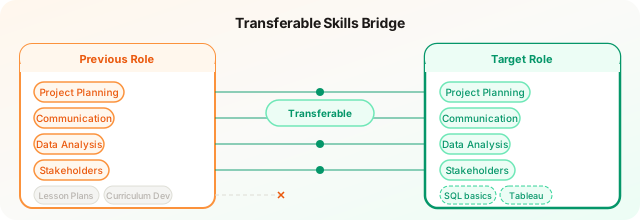
ATS systems score candidates by comparing resume content against job description content. The algorithms - whether keyword-based or semantic - work best when the resume and job description share vocabulary, title seniority markers, and recognizable career patterns. A candidate transitioning from a different industry or function enters this comparison at a structural disadvantage: fewer exact matches, no recognizable prior role titles in the target field, and experience described in the language of a different domain.
The scoring gap this creates is real. A career changer applying to a product management role with a background in consulting will likely score lower than an internal product manager candidate on raw ATS matching, even if the consulting background represents genuinely strong preparation for the role. The ATS does not understand that “structured problem-solving with ambiguous business requirements” is excellent preparation for defining product roadmaps. You have to teach it, and you do that through deliberate language choices - not by inflating or misrepresenting your background.
The Translation Exercise: Mapping Your Experience to Target-Industry Language
The most productive starting point is not your resume - it is a stack of 10–15 job descriptions for the roles you are targeting. Read them carefully enough to build a vocabulary map: what does this industry call the things you already know how to do?
Work through this translation systematically:
Your current term → Target industry term
- “Vendor management” → “Supplier relationship management” or “procurement operations”
- “Case analysis for client deliverables” → “Requirements gathering and stakeholder communication”
- “Managing project timelines across business units” → “Cross-functional project coordination” or “program management”
- “Building financial models for investment decisions” → “Financial analysis,” “FP&A,” “business case development”
This is not spin. These are genuinely equivalent competencies described in the vocabulary of a different professional community. When you apply them, you are translating accurately, not fabricating. The ATS cannot make this translation for you. If your resume says “engagement delivery” and the job description says “client project management,” semantic matching will likely connect them - but a direct match scores higher than a semantic inference, and some systems will not bridge that gap reliably.
Once you have built this vocabulary map, rewrite your experience bullets using the translated language where the underlying work genuinely matches. Do not change what you did; change how you describe it, using the words the target industry uses for that kind of work.
Which Resume Format Actually Works for Career Changers
The advice to use a functional resume when changing careers is persistent and wrong. Functional resumes - which lead with skills categories and de-emphasize chronological work history - are among the worst-performing resume formats with ATS systems.
The problem is structural. ATS parsers are designed to extract job titles, employers, and dates from a chronological format. When that structure is absent, parsers frequently misread the document, misattribute experience, or fail to build a coherent career timeline. The candidate profile that gets stored in the ATS database is garbled. Additionally, recruiters who do see functional resumes often read them as an attempt to hide something - a negative signal before they have read a word of your content.
The advice to use a functional resume when changing careers is persistent and wrong. Functional formats perform poorly with ATS systems because parsers cannot extract a coherent career timeline from them, and recruiters often read them as an attempt to hide something. A modified chronological format with a strong summary and a front-loaded skills section outperforms functional resumes for career changers in both automated and human review.
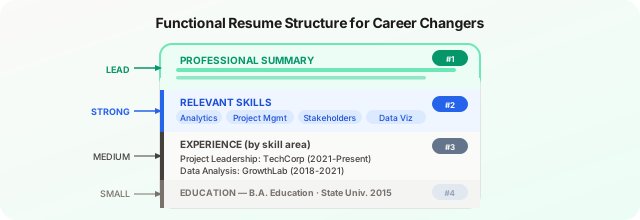
The format that works for career changers is a modified chronological resume with three deliberate structural choices:
1. A strong professional summary. This is where you explicitly frame the transition. The summary needs to do the work of making your candidacy make sense before the recruiter reads your job history - because your job history, read without context, raises questions you cannot answer from within a work bullet.
2. A prominent skills section placed before your experience. This front-loads the terminology of the target industry and improves your ATS keyword score before the parser reaches your experience section. Skills you have that are relevant to the new role should be stated explicitly here, even if they were applied in a different context.
3. Experience rewritten with translated language. The chronological content stays - your employers, your titles, your dates - but the descriptions use the vocabulary of the industry you are entering rather than the industry you are leaving.
Writing the Summary as a Transition Pitch
For career changers, the summary has a specific job: it establishes a narrative bridge between your background and the target role. It needs to acknowledge the transition rather than obscure it, because recruiters will notice the non-traditional background and they prefer a candidate who explains it clearly over one who seems to be hoping they will not look closely. For the difference between a summary and an objective statement and which works better for transitions, see resume summary vs. objective.
A summary that works follows a simple four-sentence structure:
Sentence 1: Establish your professional identity in terms of the target field, anchored in your depth of experience. “Operations leader with 9 years of experience in manufacturing logistics, transitioning to supply chain technology and analytics.”
Sentence 2: Name the transferable capabilities most relevant to the target role. Use the vocabulary of the target field. “Deep expertise in demand planning, inventory optimization, and cross-functional data analysis - now applied through Python and SQL for scalable analytics solutions.”
Sentence 3: Provide a concrete anchor. A project, a certification, a quantified outcome in the new direction. “Completed AWS Machine Learning Specialty certification in 2025 and built a forecasting model for [Company] inventory that reduced overstock by 22%.”
Sentence 4: State the transition directly. “Seeking a data analyst role in supply chain or operations where deep domain knowledge and emerging technical skills intersect.”
The summary should be 3–5 sentences. It should not be a philosophical statement about your career path. Every sentence should deliver a concrete signal about competency or fit.
Skills Gap Analysis: Honest Assessment, Prioritized Action
Career changers who succeed in ATS screening typically have two things: transferable skills that cover significant parts of the job description, and targeted new skills that address the most critical gaps.
The honest assessment process:
Step 1: Take five representative job descriptions for your target role. Extract every required and preferred skill listed.
Step 2: Sort them into three columns: “I have this,” “I have something adjacent,” and “I don’t have this.”
Step 3: In the “adjacent” column, determine which ones can be translated directly (your work in a different context used the same competency) and which require honest development.
Step 4: From the “don’t have this” column, identify the 2–3 that appear most frequently across the job descriptions. These are the critical gaps. Everything else is secondary.
Focus development effort on critical gaps first. A CFA candidate targeting fintech product management who lacks SQL knowledge should learn SQL before anything else - it is the most common filter in fintech PM job descriptions. A nurse targeting healthcare technology sales who lacks SaaS sales vocabulary should study the HubSpot and Salesforce ecosystems before applying.
Certifications and Courses: What ATS Reads and How to List Them
Certifications and completed courses are ATS-friendly content. They parse as credential entities, their keywords add to your skill coverage, and they provide evidence of intentional preparation for the new field.
List certifications in a dedicated Certifications section using the official full name followed by the issuing body and year. Do not abbreviate to just the acronym on first mention: “Project Management Professional (PMP) - Project Management Institute, 2024” gives the ATS both the spelled-out term and the abbreviation. The full formatting guidance is in how to format certifications for ATS.
For online courses and bootcamps that are not formal certifications, group them under “Professional Development” or “Training.” Name the course and the platform (Coursera, edX, LinkedIn Learning, AWS, Google). Include the completion year. These entries add keyword coverage and signal intentional upskilling even when they do not carry the weight of a formal credential.
If you are in the middle of a certification program, list it as “In Progress” with the expected completion date. Many ATS systems and recruiters treat in-progress certifications as valid signals, so omitting them entirely is leaving relevant content off your resume.
Structuring Non-Traditional Experience: Projects, Freelance, and Volunteer Work
Career changers frequently have relevant experience that does not fit neatly into their employment chronology: side projects built in the new field, freelance engagements, volunteer roles, or academic work completed during the transition.
These should be structured with the same level of formality as paid employment. Use a company name (or the project name if it was independent), a title, a date range, and achievement bullets. Format example:
Independent Projects / Freelance Work                     2024–Present
Data Analyst (Contract)
• Built demand forecasting model in Python using three years of sales data
  for regional retail client; model reduced stockout rate by 18%
• Designed Tableau dashboard for operations team tracking KPI variance
The specificity - Python, Tableau, demand forecasting, percentage outcome - is what converts this from a vague self-improvement note into a keyword-rich experience entry that ATS can score against a data analyst job description.
Targeting Roles on the Transition Spectrum
Entry-level is not the only option for career changers, and it is often not the right option. Most career changers bring depth in a domain that has value in the target field - they just need to find roles where that domain knowledge is an asset rather than irrelevant.
“Hybrid” roles deserve serious attention: product managers with a specific domain background (healthcare PM, fintech PM, supply chain product), operations analysts who need industry knowledge from your prior field, business development roles where your industry relationships are the primary asset, or technical roles that pair a technology layer with domain expertise you already possess.
These roles are easier to clear ATS for because the job descriptions specifically ask for background from your prior field. They are also often better fits strategically - you bring depth that pure-field candidates cannot. If your career change also involves explaining a gap between roles, the employment gaps guide covers how ATS handles those dates and what to say in the resume.
Cover Letter Importance for Career Changers
Career change is one of the clearest cases where a cover letter is worth writing. The ATS will not explain your transition for you. The resume summary helps, but a cover letter can make a direct, structured case for why your non-traditional background is actually an advantage for this specific role.
Keep it concrete and role-specific. Do not apologize for the transition or frame it as a limitation. Frame it as a deliberate move grounded in specific transferable value. One page maximum.
Realistic Application Volume and Timeline
Career change applications require more tailoring per submission than same-field applications. The translation work, the skills alignment, and the summary customization take time. For most career changers, a realistic pace is 5–10 heavily tailored applications per week rather than 30 generic ones. The 15-minute tailoring workflow provides a repeatable system for doing this efficiently at volume.
The tailoring is not optional if you want meaningful ATS scores. A resume designed for your prior field submitted to a target-field job posting will score poorly almost regardless of how strong your underlying background is. The customization is what converts transferable experience into readable ATS signal.
The timeline for a well-executed career change job search - building new credentials, tailoring applications, networking into the target field - is typically 3–9 months depending on how large the skills gap is and how in-demand the target role is. Treating it as a volume exercise early leads to discouragement and wasted applications. Treating it as precision work, with ATS optimization for each application, produces better outcomes.
Key takeaways
✓ Translation, not fabrication — rewrite experience bullets using target-industry vocabulary for the same underlying skills you already have
✓ Modified chronological format — keep your work history intact but add a transition-framing summary and a front-loaded skills section
✓ Vocabulary map — read 10 to 15 job descriptions in your target field before touching your resume, to learn how that industry names what you already do
✓ Hybrid roles first — targeting positions that explicitly value your prior-field background produces much higher ATS scores than competing for pure-field roles from scratch
ATS CV Checker can accelerate the tailoring process: paste the job description alongside your career-change resume and it surfaces which required skills are missing from your current text, which terms you are using that do not match the job’s vocabulary, and where the keyword gaps are most acute. That analysis turns a two-hour tailoring session into a 30-minute targeted revision.