Optimizing a resume for remote positions requires explicitly including remote-work keywords in your resume text. Recruiters run Boolean searches with terms like "remote," "distributed team," and "work from home." Collaboration tools including Slack, Jira, Notion, and Zoom should appear as explicit skills, not implied capabilities. Blank or ambiguous location fields automatically route candidates to local-only queues in many ATS configurations, blocking them from remote postings entirely.
Most job seekers select “Remote” in the location filter and assume that’s enough. It isn’t. Optimizing a resume for remote positions requires explicitly including remote-work keywords in your resume text because recruiters run Boolean searches with terms like “remote,” “distributed team,” and “work from home.” You also need collaboration tools listed (Slack, Jira, Notion, Zoom) as capability signals, and your timezone stated clearly if the role has geographic overlap requirements. Blank or ambiguous location fields often route candidates to local-only queues automatically.
The remote job market in 2026 is more fragmented than it has been since the pandemic years. Large employers have pushed return-to-office mandates with varying degrees of enforcement. At the same time, a stable layer of remote-first companies - many of them mid-sized product and services businesses - continue to hire globally without location constraints. Knowing which category you are applying to, and adjusting your resume accordingly, is more important than following generic “remote resume” advice.
How ATS Filters Remote Applications Differently
Most ATS systems are configured with a location field that candidates fill in at the application stage. But the filtering logic goes beyond that field.
Recruiter Boolean searches on platforms like Workday, Greenhouse, and LinkedIn Recruiter often include explicit modifiers: “remote OR ‘work from home’ OR ‘distributed team.’” If those terms do not appear in your resume text, you may not surface in sourcing searches even when the role is open to remote candidates. The same keyword principles that apply to any ATS search apply here - see the ATS resume keywords guide for the full methodology.
Job posting metadata also matters. When a company marks a role as “Remote - United States” or “Remote - EST timezone,” they are often configuring corresponding filters. Candidates whose location information is blank or ambiguous may be deprioritized in automated queues.
Timezone keywords are an underappreciated filter. Roles requiring EST or PST overlap frequently have ATS or recruiter filters set to exclude candidates in incompatible timezones. If you are in a compatible timezone, stating it clearly is in your interest. If you are applying through LinkedIn, see LinkedIn Easy Apply vs Direct Apply for how the platform processes remote applications differently from a company’s own ATS.
Most job seekers select “Remote” in the location filter and assume that is enough. Recruiters filling remote roles run Boolean searches with explicit modifiers: “remote OR ‘work from home’ OR ‘distributed team.’” If those terms do not appear in your resume text, you may not surface in sourcing searches even when the role is fully open to remote candidates. Selecting a filter and including the keyword in your actual resume document are two different things, and both are needed.
The Location Field: What to Write and When
This is where many remote job seekers make consequential mistakes.
If the role is explicitly remote and location is required: Write “Remote / [Your City, State]” or “Remote / [City, Country]” for international applications. This satisfies the required field, establishes your actual location for timezone inference, and signals that you are comfortable with remote work as a mode.
If the role has a preferred geography but is technically open: List your actual location. Do not obscure it. If you are in a compatible region, that works in your favor. If you are not, misrepresenting your location creates a problem at the offer stage.
If the application does not require a location field: Include “Remote” as the location of your most recent role(s) directly in the experience section. Format it the same way you would format any other city: “Senior Product Manager | Remote | Company Name | 2023 – Present.”
What not to do: Do not leave location fields blank in systems that expect them. Blank locations in ATS create parsing ambiguity and often result in a candidate being routed to a default “local applicants only” queue.
Remote-Specific Keywords That ATS and Recruiters Search For
Recruiters filling remote roles are looking for candidates who have demonstrated the capacity to work effectively without physical proximity. Your resume needs to provide that evidence through language, not just by listing “remote” as a job location.
Collaboration and Communication Tools
The tools you use function as implicit capability signals. List the ones you have used substantively:
- Communication: Slack, Microsoft Teams, Zoom, Google Meet, Loom
- Project management: Asana, Jira, Linear, Notion, Monday.com, ClickUp, Trello
- Documentation: Confluence, Notion, Coda, Google Workspace
- Design and whiteboarding: Miro, FigJam, Figma (for remote collaboration)
- Version control and async code review: GitHub, GitLab, Linear
Do not list tools you used briefly or superficially. Recruiters at remote-first companies will probe tool depth in interviews. List what you used meaningfully.
Skills and Competencies That Read as Remote-Ready
These phrases appear in ATS searches for remote roles and carry weight with recruiters evaluating distributed team candidates:
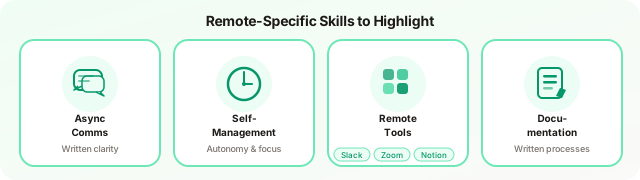
- Asynchronous communication - the ability to communicate effectively without real-time interaction
- Written communication - remote-first companies weight this heavily because most coordination happens in text
- Distributed team management (for managers) - signals experience leading people across locations and timezones
- Cross-timezone collaboration - relevant for international remote roles
- Remote project coordination - connecting deliverables to remote-specific context
- Self-directed or self-managed - signals autonomy, though use sparingly and always with supporting evidence
The strongest approach is to embed these skills in context rather than listing them abstractly. “Led a distributed team of 12 engineers across four timezones, coordinating via Notion and Loom for async updates” demonstrates the competency more credibly than “experienced with async communication.” For how to write the action verb and achievement structure that makes each bullet land, see the resume action verbs guide.
Remote-First vs. Remote-Optional: Why the Distinction Matters
Not all remote roles are equal, and your resume emphasis should reflect the type of remote culture you are targeting.
Remote-first companies (Automattic, GitLab, Doist, Basecamp, and many others in this category) have built their entire operating model around distributed work. They default to written communication, asynchronous decision-making, and documentation over meetings. When applying to these organizations, emphasize your written output, your documentation practices, and your experience working across timezones without a fallback to in-person. Listing that you “co-authored the team’s async communication guidelines” or “maintained the internal knowledge base” carries real weight.
Remote-optional or hybrid-flexible companies are different. The culture is still primarily office-oriented; remote is an accommodation, not a design principle. For these roles, remote-specific language is less critical. Emphasize outcomes, skills, and role fit rather than async methodology.
A resume that reads like a remote-work manifesto submitted to a hybrid-optional company may signal to the recruiter that you are inflexible or overly focused on working arrangement rather than the role itself.
Listing Remote Work in Your Experience Section
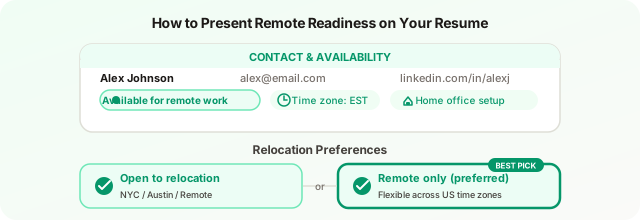
Formatting matters for ATS parsing. The location field in each experience entry is where you indicate remote status.
Single-company remote role:
Senior Marketing Manager | Remote | Acme Corp | Jan 2023 – PresentRole that transitioned from office to remote mid-tenure:
Product Designer | New York, NY → Remote | TechCo | Jun 2021 – Dec 2024Or handle it more cleanly in the description: “Role transitioned to fully remote in March 2022.”
Contractor or freelance remote work:
Independent Consultant (Remote) | Self-Employed | 2022 – PresentThe parenthetical “(Remote)” after role title or company is ATS-compatible in most modern systems and clearly signals the work mode to both the parser and the human reader.
Emphasizing Outcomes Over Presence
This is the single most important strategic shift for remote resumes, and it aligns perfectly with ATS optimization.
In a remote work context, you cannot rely on the ambient signaling of office presence: being seen in meetings, hallway conversations, visible desk-time. Your documented output is the only signal that exists. Remote-first employers know this, which is why they evaluate candidates based on what they produced, not how they worked.
For your resume, this means: every significant bullet point needs a result, not just an activity.
“Managed social media accounts” is weak in any context. In a remote application, it is invisible. “Managed social media accounts across four platforms, growing combined following by 34% and increasing inbound lead volume by 22% over 12 months” is a complete statement that works equally well for ATS keyword matching and recruiter evaluation.
If your current resume reads as a list of responsibilities rather than a record of outcomes, revising that is more valuable than any keyword addition.
Managing International and Contractor Remote Applications
If you are applying to companies in a different country for a fully remote role, several additional considerations apply:
Work authorization language: Many companies filter for candidates who can work in specific jurisdictions without visa sponsorship. If this is relevant to your situation, address it clearly in the skills or summary section: “Authorized to work in EU and UK without sponsorship.”
Currency of compensation expectations: Some ATS platforms and job boards include salary expectation fields. Research typical compensation for the target market before completing these fields to avoid automatic disqualification.
Listing contract and freelance work: For ATS purposes, treat each significant contract engagement as its own experience entry with dates, client type (you do not need to name clients if confidential), scope, and outcomes. Do not compress years of varied contract work into a single “Freelance” entry, or you lose the keyword density from each engagement and the ATS cannot extract meaningful timeline data.
The 2026 Context: RTO vs. Permanent Remote
The return-to-office pressure from large employers (Amazon, Goldman Sachs, and others mandating full-time in-office attendance) has had a real effect on the remote job market. Demand for genuinely remote roles has concentrated in specific sectors: software development, digital marketing, content, design, certain finance roles, and customer success at SaaS companies.
If you are targeting remote roles in 2026, be specific about the type of company you are targeting. A resume tailored for remote roles at a remote-first software company should emphasize different things than one submitted to a Fortune 500 that offers occasional flexible working.
The candidates who are succeeding in this market are not those who broadly signal that they prefer remote work. Employers are not filtering for enthusiasm about the arrangement. They are succeeding by demonstrating the skills, tools, and work habits that make remote collaboration effective. That demonstration happens through specific language in the resume, grounded in specific outcomes from specific roles.
Make that case directly in the document, and test it against each job description before submitting. The 15-minute tailoring workflow is the most efficient way to do this consistently across a high volume of remote applications.
Key takeaways
✓ Include remote keywords in the document body — “remote,” “distributed team,” and collaboration tool names need to appear in your resume text, not just in filter settings
✓ Location field format — write “Remote / City, State” to satisfy required fields while signaling remote availability; blank location fields route to local-only queues
✓ Tools as capability signals — list Slack, Jira, Notion, Loom, and other async tools you used substantively; these are filtered in Boolean searches
✓ Remote-first vs remote-optional — a resume emphasizing async methodology is right for Automattic but may signal inflexibility to a hybrid-optional company
✓ Outcomes, not presence — document what you produced, not how you worked; remote employers evaluate candidates on results, and your resume should reflect that