ATS systems treat certifications as credentialing signals and often apply them as hard knockout filters. A missing required certification eliminates your application regardless of other qualifications. Always list each credential with both the spelled-out name and its abbreviation, such as "Project Management Professional (PMP)," because ATS platforms vary in whether they equate the two forms, and a recruiter Boolean search for one form will exclude a resume that only contains the other.
ATS systems treat certifications as credentialing signals and often apply them as hard knockout filters, meaning a missing required certification eliminates your application regardless of other qualifications. Always list each credential with both the spelled-out name and its abbreviation - “Project Management Professional (PMP)” - because ATS platforms vary in whether they equate the two forms, and a recruiter Boolean search for one form will exclude a resume that only contains the other.
Certifications occupy a specific position in the ATS scoring model that most candidates do not fully understand. They function differently from skills (where you list a competency you have) and differently from experience (where you demonstrate a competency through work history). ATS systems treat certifications as credentialing signals (external validation of a specific capability), and many job requisitions have explicit certification requirements that function as knockout filters. Get this section wrong and you may lose points that are straightforward to earn.
How ATS Systems Identify Certifications
Most enterprise ATS platforms use two parallel methods to process certification data.
Dedicated certification fields. In the application flow on platforms like Workday, Greenhouse, and iCIMS, there is often a structured certifications section where candidates enter credentials explicitly. This data is extracted cleanly and matched directly against required credentials in the requisition. If a job requires a PMP and you enter it in the structured field, the match is clean and reliable.
Resume text parsing. In parallel, the ATS parses the certification content from your uploaded resume document. This is where formatting and naming convention matter. The parser looks for recognizable credential patterns: known abbreviations (PMP, CPA, AWS SAA), spelled-out credential names, issuing organization names, and year indicators. If your certifications are buried in an unusual section with a non-standard header, or if the credential name does not match any known pattern in the system’s credential taxonomy, the parser may miss them entirely.
Always fill in both the structured application fields and include certifications clearly in your resume document. Do not rely on one channel alone.
The Abbreviation Problem: Always Use Both Forms
This is the single most consistently missed certification mistake. ATS systems vary in whether they equate abbreviations with spelled-out names. Some do; many do not. The safe approach is to include both on every credential:
Project Management Professional (PMP) - not just “PMP” and not just “Project Management Professional.”
Certified Public Accountant (CPA) - not “CPA” alone.
AWS Certified Solutions Architect – Associate (AWS SAA-C03) - include the credential tier and exam code where applicable, because employers searching for specific AWS tiers will search by those exact terms.
Chartered Financial Analyst (CFA), Level III - including the level matters for roles that specify a minimum CFA level.
ATS systems treat certifications as credentialing signals that can function as hard knockout filters: a missing required certification eliminates your application before any human reviews it, regardless of how strong the rest of your background is. Listing credentials with both the spelled-out name and the abbreviation on every entry prevents the most common and entirely avoidable cause of elimination.
The reason to include both forms is straightforward: if a recruiter runs a Boolean search for “Project Management Professional” and your resume only says “PMP,” you are excluded from a result set you should be in. The reverse is equally true. Writing out both forms takes ten seconds and eliminates the risk.
High-Value Certifications by Field
The certifications worth including on a resume are those that either satisfy a knockout filter, meaningfully improve your keyword score for targeted roles, or signal credibility in your domain. Not all certifications serve these functions equally.
Technology and Engineering
Cloud platforms: AWS certifications (Solutions Architect, Developer, SysOps, and specialty tracks), Google Cloud Professional certifications, and Microsoft Azure certifications are among the most frequently searched terms in technical job postings. Including the full credential name, common abbreviation, and the certification tier (Associate, Professional, Specialty) ensures maximum keyword coverage.
Kubernetes and container orchestration: Certified Kubernetes Administrator (CKA) and Certified Kubernetes Application Developer (CKAD) are frequently required filters in DevOps and platform engineering roles.
Security: Certified Information Systems Security Professional (CISSP), Certified Ethical Hacker (CEH), CompTIA Security+, and CISM are frequently searched for security-specific roles. CISSP in particular often appears as a requirement rather than a preference.
Project and product management: Project Management Professional (PMP) is one of the most widely searched credentials across industries. Scrum Master certifications (Certified ScrumMaster from Scrum Alliance, Professional Scrum Master from Scrum.org) appear frequently in technology and product management postings.
Finance and Accounting
Chartered Financial Analyst (CFA): One of the most rigorous and credible credentials in investment management. Include the level you have completed.
Certified Public Accountant (CPA): A functional requirement for many accounting and auditing roles. Include your state licensure if applicable: “CPA, Licensed in New York.”
Financial Risk Manager (FRM): Valued in risk management, quant finance, and treasury roles.
Certified Financial Planner (CFP): Required or strongly preferred for financial advisory and wealth management roles.
FINRA licenses: Series 7 (General Securities Representative), Series 63 (Uniform Securities Agent State Law), Series 65 (Uniform Investment Adviser Law). List the specific series number and the license name: “FINRA Series 7 (General Securities Representative).”
Marketing and Digital
Google Ads (formerly AdWords) Certification: List as “Google Ads Certification” or “Google Ads Certified,” since recruiters search both. Include the specialization if applicable (Search, Display, Video, Shopping).
HubSpot Certifications: HubSpot Inbound, HubSpot Marketing Hub Certification. Common in inbound marketing, content, and demand generation roles.
Meta Blueprint Certification: Relevant for paid social roles. List as “Meta Blueprint Certified” and include the specific credential (e.g., Media Buying Certification).
Salesforce certifications: Salesforce Certified Administrator, Salesforce Marketing Cloud Email Specialist, and Salesforce Certified Sales Cloud Consultant are frequently searched in CRM and marketing operations roles.
Google Analytics 4 (GA4): The legacy Universal Analytics certification is obsolete. List “Google Analytics Certification (GA4)” explicitly, since the platform migration has made this distinction relevant in searches.
Healthcare
State professional licenses: These are typically required, not merely preferred, and function as knockout filters. Include the full credential name, the issuing state, and the license number if the application requires it: “Registered Nurse (RN), Licensed in California, License #XXXXXX.”
Board certifications: American Board of [Specialty] certifications should be spelled out fully on first mention. “Board Certified in Internal Medicine (ABIM)” is preferable to “ABIM board certified.”
BLS, ACLS, PALS: Include if required for the role. Format: “Basic Life Support (BLS) Certified, AHA.”
Data and Analytics
Tableau Desktop Specialist and Tableau Certified Data Analyst: Both are searched in data analyst and business intelligence roles. Include whichever level you hold.
Microsoft Power BI Data Analyst Associate: A formal Microsoft certification that carries weight in enterprise analytics roles. Distinguish this from general Power BI experience.
Google Data Analytics Certificate: A Coursera-hosted certificate from Google. Credible as an entry signal for junior analyst roles. It is not equivalent to the Google Analytics certification above, so include the full name to avoid ambiguity.
Where to Place Certifications on Your Resume
The right location depends on how critical the certifications are to the target role.
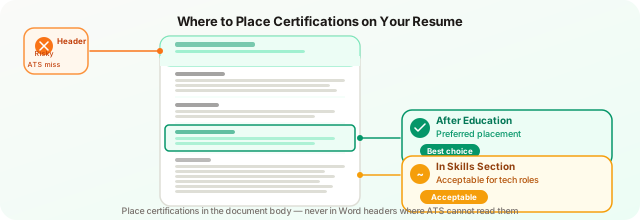
If certifications are a stated requirement: Include them in two places: in a dedicated Certifications section, and in the skills section or professional summary with language that surfaces them early. A required PMP should appear in your summary (“PMP-certified project manager…”) so it reads immediately, not just in a section a recruiter scrolls to.
If certifications are relevant but not required: A dedicated Certifications section, placed after Skills or after Education (in that order of preference). Keeping it as a separate, clearly labeled section ensures the ATS parser assigns it to the correct content category.
If you hold many certifications: List only those directly relevant to the target role. A project manager applying to software development roles should emphasize PMP and any Agile certifications, not the Google Analytics certificate from a side project. Irrelevant credentials dilute the signal.
The Correct Format
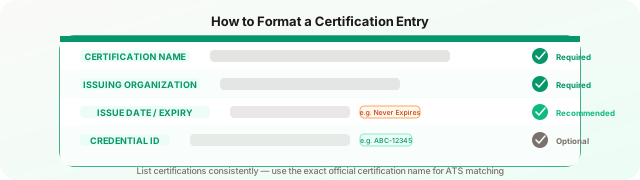
ATS parsers look for recognizable patterns. The most reliably parsed format is:
Certification Name (ABBREVIATION), Issuing Organization, Year Earned
Example:
- Certified Information Systems Security Professional (CISSP), ISC2, 2023
- AWS Certified Solutions Architect – Professional (AWS SAP-C02), Amazon Web Services, 2024
- Project Management Professional (PMP), Project Management Institute, 2022
If you have a renewal or expiration year that differs from the original year, include both: “Originally certified 2019, renewed 2025.”
Expired Certifications
Remove them. An expired certification is a former credential, not a current one. Including it with the original year and no renewal indicator implies it is current, which creates a credibility problem if discovered in screening or reference checks.
If you are actively in the renewal process, treat it the same as an in-progress certification (see below) rather than listing the expired date.
In-Progress Certifications
Listing a certification you are currently pursuing is acceptable and can strengthen your application for roles where that credential is required or preferred. The format matters:
AWS Certified Solutions Architect – Associate (in progress, expected Q2 2026)
This tells the recruiter: the credential is pending, not held. That distinction is important. Representing an in-progress certification as a current credential creates a misrepresentation that frequently surfaces in verification. The “(in progress)” notation is the honest and professional approach.
Recruiters evaluating candidates for roles that require a certification will weigh an in-progress credential differently than a held one, but for some roles it is enough to keep you in consideration, particularly if your other qualifications are strong.
Online Courses and Self-Paced Programs: When to List Them
This is where standards have shifted considerably in the past three years.
Credible and worth listing:
- Google-issued certificates through Coursera (Google Data Analytics, Google Project Management, Google Cybersecurity)
- IBM certifications on Coursera and edX
- AWS training paths that result in AWS-recognized credentials
- LinkedIn Learning certificates tied to specific, measurable skills - list only if the topic is directly relevant and not covered elsewhere on your resume
- University-affiliated programs with verifiable completion records (MIT OpenCourseWare assessments, Wharton Online certificates)
Generally not worth listing:
- Generic Udemy or YouTube completion certificates for popular topics
- Single-session webinars or conference workshop certificates
- Internal company training completions (unless proprietary methodology with industry recognition)
The test: Would a hiring manager in your field recognize the issuing organization as credible? Would they be able to verify it? If both answers are yes, it is worth listing. If either is no, omit it.
The 2026 Context: AI and ML Certifications
The proliferation of AI-related certificates since 2023 has created a specific evaluation challenge. Hundreds of new programs claim to certify AI and ML competency, ranging from rigorous technical credentials to weekend courses that issue certificates on completion of a basic quiz.
Credible AI/ML credentials in 2026:
- Google Professional Machine Learning Engineer - a formal Google Cloud certification requiring substantial applied ML knowledge
- AWS Certified Machine Learning – Specialty - one of the more demanding cloud ML certifications
- Deep Learning Specialization (deeplearning.ai / Coursera) - while a course-completion certificate rather than a professional credential, it is recognized in the technical hiring community and worth listing for technical roles
- TensorFlow Developer Certificate - Google-issued, verifiable
- NVIDIA Deep Learning Institute certificates - recognized in GPU-accelerated computing contexts
Certificates that carry little weight in 2026: Any program offering an “AI Professional” or “AI Expert” certificate for completing a few hours of video content, regardless of platform. Recruiters filling serious AI/ML roles are aware of the difference.
The reliable principle: credentials issued by platform companies (Google, AWS, Microsoft, NVIDIA) that require demonstrable performance on a proctored assessment carry genuine weight. Completion certificates from course marketplaces do not.
Key takeaways
✓ Both forms always — include the spelled-out name and the abbreviation for every credential, since ATS platforms vary in whether they equate the two
✓ Hard knockout filters — required certifications eliminate candidates automatically; missing one means no human ever sees your application
✓ Placement matters — required certifications belong in both a dedicated section and in your professional summary, so they are visible in the first scan
✓ Platform-issued credentials carry weight — certifications from Google, AWS, Microsoft, and NVIDIA require demonstrable performance; course completion certificates from general marketplaces do not carry equivalent credibility
List your certifications accurately, keep the section maintained as credentials expire or are renewed, and test your resume against each role’s stated requirements before submitting. A correctly structured certifications section takes 15 minutes to maintain and can be the difference between clearing a knockout filter and not.
Keep reading:
- One Page vs Two Page Resume: What Recruiters and ATS Actually Prefer in 2026
- Tech Layoff Resume: How to Stand Out When 400+ Engineers Apply to the Same Role
- HR Resume and ATS in 2026: The Irony of HR Professionals Getting Filtered Out
- Resume Summary vs Objective: Which One ATS and Recruiters Actually Prefer