Listing "excellent communication skills" as a bare keyword does not improve your ATS score. In AI-augmented screening systems, unsubstantiated soft skill keywords can actively lower it. The approach that works is demonstrating soft skills through specific, quantified experience bullets. "Managed 9 engineers across 2 geographies with 94% retention over 3 years" signals leadership more credibly than any keyword claim, to both the scoring algorithm and the recruiter reviewing the shortlist.
Does listing “excellent communication skills” on your resume actually improve your ATS score? No. And in AI-augmented screening systems, bare soft skill keywords can actively hurt you. The approach that works is demonstrating soft skills through specific, quantified examples in experience bullets. “Managed team of 9 engineers across 2 geographies with 94% retention over 3 years” signals leadership more credibly than any keyword claim, to both the ATS and the recruiter reading the shortlist.
“Excellent communication skills. Strong leadership. Team player. Detail-oriented.” These phrases appear on roughly 80% of resumes. They appear because candidates believe they matter, and they do - just not the way most people include them.
In AI-augmented screening systems, a high density of bare soft skill keywords correlates negatively with candidate quality scores. These systems were trained on millions of resumes and learned that candidates who rely heavily on generic soft skill terms tend to have thinner evidence elsewhere. The unintended result is that listing “leadership” and “communication” without supporting bullets can actively lower your score rather than improve it.
Listing soft skills as bare keywords in a skills section does not help your ATS score. In most configurations, it actively hurts it.
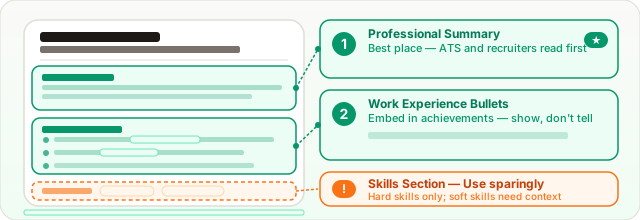
Why Soft Skills Fail in ATS Scoring
Modern ATS systems, particularly those using AI-augmented screening, have been trained on millions of resumes. They have learned that generic soft skill terms - communication, leadership, teamwork - are near-universal and therefore carry almost no signal about candidate quality. Including them as standalone keywords does not improve your match score for most job descriptions.
In AI-augmented screening layers (the kind that sit on top of the traditional ATS and generate recruiter summaries), researchers have found that high density of bare soft skill terms correlates negatively with candidate quality scores. The AI has learned that candidates who rely heavily on soft skill keywords tend to have thinner actual evidence elsewhere.
The second problem: most job descriptions include soft skill requirements in their language, but the ATS does not necessarily weight those terms as heavily as technical skills, certifications, and specific methodologies. If “strong communicator” appears in the JD’s “nice to have” section, mirroring that phrase adds minimal score value.
What Does Work: Evidence-Based Demonstration
Soft skills work on a resume when they are demonstrated through specific, measurable examples rather than claimed as abstract qualities.
The difference:
Ineffective: “Excellent communication skills”
Effective: “Presented quarterly roadmap to C-suite audience of 12 executives; written proposals led to approval of $2.3M annual budget for product infrastructure.”
Both communicate that this person can communicate well. The second version does so with evidence that an ATS can extract keywords from (C-suite, executives, $2.3M, budget, infrastructure, quarterly) and that a human reviewer can evaluate as genuine.
Here is how to handle the most commonly requested soft skills:
Leadership
What not to write: “Strong leader. Natural leader. Leadership skills.”
What to write: Bullets with strong action verbs that demonstrate the specific form of leadership the role requires.
For team leadership: “Managed team of 9 software engineers across 2 geographies, conducting weekly 1:1s, running quarterly performance reviews, and maintaining 94% team retention over 3 years.”
For influence without authority: “Drove adoption of standardized API design guidelines across 4 engineering teams without direct management authority, achieving full compliance within 8 weeks.”
For crisis leadership: “Led incident response for 6-hour production outage affecting 400K users, coordinating real-time communication to engineering, product, and executive stakeholders while maintaining customer SLA within contractual bounds.”
Each of these is specific enough that an ATS can extract meaningful signals (numbers, scope, outcomes) and a human reviewer can assess whether the described leadership matches the role’s requirements.
Communication
Communication on a resume should be specified by type: written, verbal, executive-level, technical, external-facing, public, cross-functional.
Written communication: “Authored 12-article technical blog series that accumulated 85,000 views and was cited in 3 industry publications within first year.”
Or: “Created client-facing project status reports consumed by VP and Director-level stakeholders at 7 Fortune 500 accounts.”
Verbal and presentation: “Delivered 45-minute keynote at regional industry conference (340 attendees); presented to PMO steering committee monthly.”
Cross-functional communication: “Served as primary liaison between engineering and product teams during 18-month platform rewrite, running biweekly alignment sessions with 4 department leads.”
External communication: “Managed customer escalations for enterprise accounts ($500K+ ARR), resolving 94% of issues within SLA without escalation to director level.”
Collaboration and Teamwork
“Team player” is one of the least useful phrases on any resume. Replace it with evidence of how you specifically collaborated and what it produced.
“Partnered with 3 external design agencies on brand refresh project, coordinating deliverables and feedback cycles over 7 months to deliver rebrand on schedule.”
Or: “Joined cross-functional task force (engineering, legal, compliance, product) to respond to SOC 2 Type II audit readiness; completed 140-item control checklist in 60 days.”
Or: “Collaborated with counterpart in EMEA region to standardize reporting methodology across 2 regional teams, reducing duplicated analysis effort by 6 hours per week.”
These bullets show collaboration and teamwork through specific, verifiable events. They also contain terminology and context that adds keyword value to your resume.
Problem-Solving
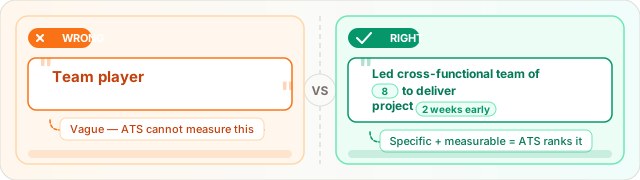
What not to write: “Creative problem-solver. Analytical thinker.”
What to write: A problem described specifically, with your intervention and the outcome.
“Identified root cause of recurring month-end reconciliation errors (incorrect inter-company elimination logic in ERP configuration); developed fix that eliminated 4-hour monthly manual correction process.”
Or: “Diagnosed performance degradation in recommendation engine traced to N+1 query problem introduced during v3.2 release; patch reduced API response time by 340ms at median.”
These bullets demonstrate analytical thinking and problem-solving through actual examples. They also contain technical vocabulary (ERP, N+1 query, API response time) that contributes to your keyword score for relevant roles.
Adaptability
“Adaptable” as a standalone skill is meaningless without a definition of what you adapted to. Make it specific.
“Transitioned from waterfall to Agile delivery model mid-program after executive leadership change; completed remaining 8 sprints on revised methodology while maintaining delivery commitments.”
Or: “Absorbed 40% increase in support volume following merger integration without additional headcount, maintaining existing SLA by implementing triage workflow and self-service knowledge base.”
Time Management and Prioritization
“Strong time management” signals nothing. Show the structure you actually used.
“Managed simultaneous delivery of 3 active client implementations ($1.2M combined project value) using weekly priority-stacking sessions with project sponsors to resolve resource conflicts.”
Or: “Maintained 97% on-time delivery across 60+ concurrent service tickets over 18 months by implementing automated triage and SLA-based prioritization queues.”
The One Situation Where Soft Skill Keywords Still Help
Some ATS systems, particularly older Taleo and iCIMS configurations, do score against bare soft skill keywords from the job description. If you see “demonstrated leadership” or “strong communication skills” in the required qualifications section of a job posting, include those exact phrases somewhere in your resume - but in context, not as isolated list items.
You can include them in your summary: “…a skilled communicator who has presented to C-suite audiences and led cross-functional teams of 20+.”
Or at the end of a bullet: “…requiring clear communication across engineering, product, and business stakeholders.”
This approach gets the keyword into your document without the credibility cost of a bare soft skills list.
A Note on the Skills Section
Remove generic soft skills from your skills section entirely. What belongs in a skills section:
- Technical tools and platforms
- Programming languages and frameworks
- Domain knowledge (revenue cycle, supply chain, regulatory frameworks)
- Languages (Spanish, Mandarin, etc.)
- Methodologies (Agile/Scrum, Six Sigma, PRINCE2)
- Certifications (abbreviation only - full name in the certifications section)
What does not belong in a skills section:
- Communication
- Leadership
- Teamwork
- Problem-solving
- Detail-oriented
- Results-driven
- Strategic thinking
- Passionate
If a soft skill is important enough to mention, it is important enough to demonstrate with a specific example. If it cannot be demonstrated with a specific example, it probably should not be on your resume.
The rule of thumb: every item in your skills section should be verifiable and falsifiable. “Python” is verifiable - you either know it or you do not. “Detail-oriented” is neither.
Key takeaways
✓ Evidence over claims — every soft skill should appear through a specific, quantified bullet in experience, not as a standalone keyword in the skills list
✓ Specify the type — “communication” is too broad; written communication, executive-level presentation, and cross-functional coordination each signal something distinct
✓ Remove from skills section — generic soft skills take up space that specific tools, methodologies, or certifications could occupy with meaningful scoring weight
✓ Context placement — if a job description requires a specific soft skill phrase, include it in your summary or at the end of a relevant bullet, not as an isolated list item