Your resume faces three evaluators in sequence: an ATS that scores keyword overlap, a human recruiter who scans for title match and career narrative in under 10 seconds, and increasingly an AI summarization layer that frames your profile for the hiring manager. Each has different failure modes. A resume optimized for only one will consistently underperform with the others, costing you interviews even when you meet the qualifications.
Who actually decides whether your resume advances - the software or the person? Both, but at different stages and for different reasons. Your resume faces three evaluators in sequence: an ATS that extracts structured data and scores keyword overlap, a human recruiter who scans for title match and career narrative in under ten seconds, and increasingly an AI summarization layer that frames your profile for the hiring manager. Each has different failure modes. A resume optimized for only one will underperform with the others.
When you submit a resume, you are not writing for one reader. You are writing for at least two very different evaluators with different information needs, different time constraints, and different definitions of a qualified candidate. Understanding how each one processes your document, and where their criteria conflict, is the most practical framework for improving your application outcomes.
In 2026, for many roles at larger organizations, the evaluation chain has expanded to three layers. Understanding all three is now part of the baseline.
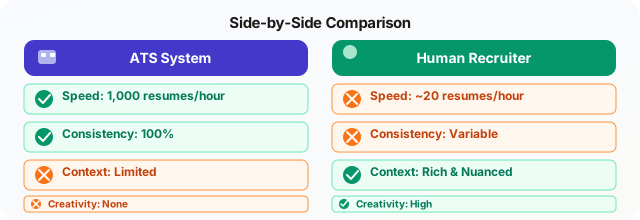
The Evaluation Chain: How Your Resume Actually Gets Reviewed
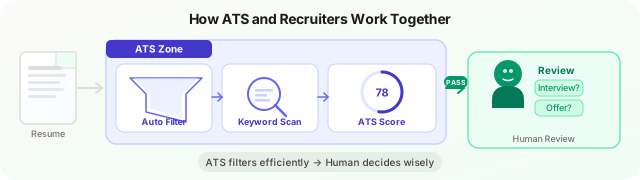
At most companies with structured hiring processes, resumes move through this sequence:
- ATS screening - automated, algorithmic, applied to every application
- Human recruiter review - applied to candidates who passed ATS filtering
- AI-assisted scoring or summarization - applied at some organizations as a bridge between ATS output and hiring manager review
Each stage has a different failure mode. A resume that fails the ATS never reaches a human. A resume that passes the ATS but fails the recruiter never reaches the hiring manager. A resume that passes both but is summarized poorly by an AI layer may reach the hiring manager with the wrong framing.
Stage One: What ATS Systems Evaluate
ATS evaluation is fundamentally about signal extraction and threshold matching. The system is attempting to answer a structured question: does this candidate meet the defined criteria for this role?
Keyword Presence and Density
The most basic ATS function is keyword matching. Job requirements, both explicit and implicit, generate a vocabulary, and the system checks whether your resume contains that vocabulary. This is not a nuanced process. “Project management” and “managing projects” may or may not be treated as equivalent depending on the system’s sophistication.
In practice, this means: use the exact language from the job posting where it accurately describes your experience. Do not assume the system will infer equivalence between synonyms unless you have reason to believe it uses semantic matching (more common in enterprise systems running LLM overlays, discussed below).
Keyword density matters, but there is no universal threshold. Mentioning a key skill once is not enough; mentioning it seven times is keyword stuffing that may trigger filters or read as incoherent to humans. Two to four appearances of a critical skill, in your summary, in your skills section, and in at least one experience bullet, is typically sufficient.
Required Credentials
Many ATS configurations include hard filters for credentials that are non-negotiable for the role: specific degrees, active certifications, years of experience thresholds, or professional licenses. These are often implemented as knock-out questions during the application process, but some are also inferred from resume content.
If you have the credential, make it explicit and clearly labeled. “AWS Certified Solutions Architect – Professional (2023)” is unambiguous. “Cloud infrastructure experience” is not. The system cannot award credit for a credential it cannot confirm.
Location and Work Authorization Signals
For roles with geographic requirements or work authorization requirements, ATS systems often filter on location (inferred from resume address or application form answers) and authorization status (typically captured via application form). This is less about your resume text and more about accurate disclosure in the application.
Your resume faces three distinct evaluators in sequence. Failing at any one stage ends your candidacy regardless of how well you perform at the others. A resume that passes ATS but fails the human recruiter scan in the first ten seconds is no better than one that never cleared the initial filter.
Title Match
The similarity between your most recent job title and the title of the role you are applying for is a weighted factor in most scoring algorithms. This does not mean your title needs to be identical, but unconventional or internally-specific titles can hurt your ATS score even when your actual work is a strong match.
Some candidates legitimately modify their listed title to reflect what their role actually was (e.g., “Software Engineer” listed by the company as “Technical Analyst II”). This is defensible when accurate; it is misrepresentation when it is not.
Skills Taxonomy Match
Enterprise ATS platforms maintain structured skills taxonomies - Workday, for example, uses the EMSI Burning Glass dataset. When a job is posted, the system maps the requirements to taxonomy nodes. When a resume is parsed, it maps candidate skills to the same taxonomy. The match score reflects how well the candidate’s taxonomy coverage aligns with the role’s requirements.
Niche or proprietary tool names may not exist in the taxonomy and may not be credited. When a specific tool is central to your experience, also mention the underlying technology category it belongs to. “Salesforce” is in the taxonomy; your company’s custom CRM built on Salesforce may not be.
Stage Two: What Human Recruiters Evaluate
Human recruiter review is faster, more subjective, and more contextual than ATS screening. The recruiter is not attempting to extract structured data - they are making a holistic judgment about whether this candidate warrants further investment.
Career Trajectory and Logical Progression
Experienced recruiters read a resume chronologically and assess whether the candidate’s career makes sense. Promotions, increasing scope, lateral moves into adjacent domains - these tell a coherent story. What causes pause:
- Unexplained gaps: A gap of three months or more without explanation creates uncertainty. Brief contextual labels (“Career break - family care,” “Layoff, actively seeking”) are better than silence.
- Declining scope: A move from a senior role to a junior role, or from a larger company to a significantly smaller one, raises questions. There are legitimate reasons, but the recruiter needs a way to understand them.
- Frequent short tenures: Multiple roles under 18 months, especially in the recent past, signals a pattern that many recruiters treat as risk.
None of these are automatic disqualifiers. They are friction points that a recruiter has to resolve before passing the candidate forward, and friction reduces the likelihood of that happening.
Company Brand and Context Signals
Recruiters, consciously or not, use company names as proxies for experience quality. A candidate from a recognizable company in the relevant industry carries an implied credibility signal. A candidate from an unknown company faces a higher burden of explanation.
This is about the recruiter’s ability to mentally model what the candidate’s experience actually was, not prestige for its own sake. When a company name is well-known, the recruiter can make inferences. When it is not, the resume has to carry more of that explanatory load through specific, concrete descriptions of scope and scale.
If you have worked at smaller or lesser-known companies, include brief context: the industry, approximate size, or relevant business model. “Series B fintech startup, 80 employees” gives a recruiter enough to understand the environment without requiring research.
Quantified Achievements Over Responsibilities
This distinction is critical and widely under-executed. A resume that lists responsibilities is describing a job description. A resume that lists quantified achievements is describing what you actually did in the role.
Recruiters with experience recognize the difference immediately. Bullet points like “Responsible for managing client relationships” are filtered out cognitively within seconds. Bullet points like “Managed 32 enterprise accounts totaling $4.8M ARR, achieving 97% renewal rate in 2024” carry weight.
Every bullet point that can be quantified should be quantified. Not all experience has clean metrics, but candidates consistently underestimate how much can be expressed numerically: team size, budget managed, project timeline, volume processed, percentage improvement, revenue influenced.
Formatting and Visual Hierarchy
Recruiters do not read resumes linearly. They scan. They look for structure that makes the highest-value information easy to locate in six to ten seconds. Formatting choices that impede this scan, dense paragraphs instead of bullets, inconsistent visual hierarchy, a design-heavy template that buries content inside graphic elements, cost you time that you do not have.
There is a calibration here: a resume that looks generic but is easy to scan performs better than a resume that looks distinctive but is hard to read. Design should serve navigation, not substitute for content.
Red Flags and Title Inflation
Experienced recruiters notice inconsistencies. Job titles that seem inflated relative to the responsibilities described, dates that do not add up, skills listed that the experience section does not support - these create skepticism that is difficult to recover from later in the process.
The most common form of title inflation is listing a senior title while describing entry-level responsibilities. The second most common is claiming proficiency in a tool or technology that appears nowhere in the work history.
Stage Three: AI-Assisted Screening in 2026
A growing number of large employers, particularly those in technology, finance, and healthcare, now use AI tools between ATS filtering and recruiter review. These tools operate differently from ATS keyword matching, and most candidates are not aware they exist.
The most common implementations:
Summarization: An LLM reads the parsed resume and produces a structured summary, typically one paragraph plus a skills/experience extraction. This summary is what the recruiter sees in their queue, not the resume itself. If the summarization misses something important, the recruiter may never know it was there.
Scoring against requirements: Some systems prompt the LLM to rate the candidate against each job requirement on a 1–5 scale, producing a composite score used for ranking. These ratings are influenced by framing and context, not just keyword presence.
Fit narrative: A small number of systems generate a short narrative (“This candidate has strong Python experience but lacks the required management background”) that frames the recruiter’s initial read of the candidate.
How clearly you state things matters as much as what you state. Ambiguous bullets, unexplained acronyms, and implicit claims (“contributed to team success”) do not summarize well. Explicit, concrete statements (“Led a team of 6 engineers to deliver the payments redesign, reducing checkout abandonment by 22%”) survive summarization intact.
Where ATS and Human Criteria Conflict
The clearest conflict is around keyword density versus readability.
An ATS scores based on term frequency and matching. This creates pressure to repeat keywords. A human reader finds keyword repetition jarring and unprofessional. Repeating “project management” six times in a resume signals, to a human, that the candidate does not know how to write.
The resolution is not to optimize for one and ignore the other. Meet the keyword threshold for the ATS (two to four appearances of critical terms, across different sections) while writing bullets in natural, specific language that serves human readers.
A related conflict: ATS systems often prefer plain text in standard fonts, with no tables, columns, or graphics. Human readers are influenced by visual presentation and may perceive a plain, unformatted resume as less credible. The pragmatic answer for most candidates is a clean, single-column format with clear headings - it reads well to humans and parses reliably for machines. Elaborate two-column templates with header graphics fail both.
The Unified Strategy
Rather than optimizing separately for each stage, a resume built on these principles satisfies all three evaluators:
Explicit, specific language: Every claim that can be made concrete should be. This serves keyword extraction for ATS, achievement signaling for human recruiters, and summarization fidelity for AI tools.
Structured formatting: Standard section headers (Summary, Experience, Skills, Education), clear bullet points, no text in image elements or graphics, single-column layout. This is parseable by ATS, scannable by humans, and readable by AI.
Tailoring to the job posting: The vocabulary of your resume should reflect the vocabulary of the posting. This is not fabrication - it is translation of your real experience into the language of the role. Do it for every application.
Front-loaded impact: Your most relevant and impressive content belongs on the first half of page one. Both the six-second human scan and the ATS ranking algorithm weight what appears first. Save supporting details for later in the document.
The Tailoring Question
A legitimate strategic question: one master resume tailored once, or multiple versions tailored to each application?
For most candidates, the honest answer is a targeted base document plus targeted customization. The core structure, work history, quantified achievements, education, stays constant. The summary, the skills section, and the framing of bullets in your most recent roles get adjusted for each application to match the specific posting.
This is the same communication principle that applies to any professional document: effective writing considers its audience. A resume for a data engineering role at a healthcare company and a resume for a data engineering role at an e-commerce company should read differently, because the audience’s priorities are different.
Full customization for every application is time-intensive but produces materially better results. Partial customization, summary and skills section only, is a practical compromise that improves outcomes without requiring a complete rewrite each time.
Red Flags by Stage
Some failures are stage-specific:
Passes ATS, fails human review: Dense keyword lists without context. Functional resume format (hides career gaps but makes chronology impossible to assess). Titles inconsistent with responsibilities described.
Passes human review, fails AI summarization: Implicit achievements that require context to understand. Heavy use of internal jargon or proprietary system names without explanation. Passive voice throughout (“was responsible for,” “duties included”) that makes it difficult for a summarization model to extract agent-and-action pairs.
Passes all filters but fails later: Significant discrepancies between resume and LinkedIn profile. Achievements that cannot be substantiated in conversation. Skills listed that the candidate cannot demonstrate.
Key takeaways
✓ Three-stage evaluation — ATS, human recruiter, and AI summarization each have separate failure modes that require separate optimization
✓ Keyword density balance — two to four appearances of a critical skill across different sections satisfies ATS without triggering keyword-stuffing flags for human readers
✓ Explicit, concrete language — specific statements survive AI summarization intact; vague or implicit claims get lost in translation
✓ Unified strategy — standard formatting, quantified achievements, and job-posting vocabulary serve all three evaluators simultaneously
The resume is not the end of the evaluation process - it is an entry credential. What it needs to do is get you to the conversation where you can actually demonstrate your fit. That requires passing each stage, not just one.