AI resume screening in 2026 operates in three sequential layers before a recruiter opens your file: traditional ATS keyword parsing, an AI scoring model from vendors like Eightfold or HireVue, and an LLM summarization tool. Over 98% of Fortune 500 companies use at least one of these layers. Keyword stuffing is counterproductive because AI layers discount skill claims unsupported by actual work experience.
98% of Fortune 500 companies now use AI-powered resume screening, up from 67% in 2020. Your resume passes through three automated filters before a hiring manager sees it: ATS keyword parsing, an AI scoring model from vendors like Eightfold or HireVue, and an LLM tool that summarizes candidates for recruiters. Keyword stuffing is counterproductive here. AI layers discount skill claims that lack supporting work experience.
The resume you send to a Fortune 500 company in 2026 passes through more layers of automated evaluation than most candidates realize. Understanding what those layers are, and what each one is actually looking for, is no longer optional if you want to compete seriously in the job market.
The 2026 Recruitment Tech Stack
The hiring pipeline at most large employers now operates in three distinct layers, and they work very differently from each other.
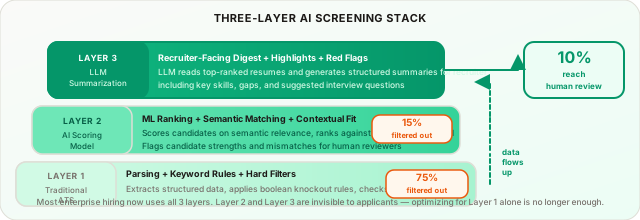
Layer 1: Traditional ATS - Systems like Workday, Greenhouse, Lever, and iCIMS still handle resume intake, candidate tracking, and data storage. They parse your resume into structured fields: name, contact info, work history, education, skills. This parsing is rule-based and brittle. A misformatted date or an unconventional section header can cause data to be dropped entirely. For a deep dive into how this layer works, see how ATS systems work in 2026.
Layer 2: AI Scoring - Sitting on top of the ATS, AI scoring models (often from vendors like Eightfold, HireVue, Paradox, or proprietary systems at large tech companies) rank candidates before a recruiter ever opens a single resume. These models are trained on historical hiring data and evaluate candidates against a learned profile of what “success” in a given role looks like at that company.
Layer 3: LLM-Assisted Screening - The newest addition. For context on how AI adoption has changed hiring practices, see AI resume trends in 2026. Recruiters at many mid-to-large employers now use AI assistants, essentially enterprise deployments of GPT-4-class models, to summarize candidate profiles, surface top applicants, and answer questions like “which of these 200 candidates has the strongest background in enterprise SaaS sales?” This layer is conversational and contextual in ways earlier systems were not.
Understanding which layer is likely to touch your resume matters, because each has different failure modes.
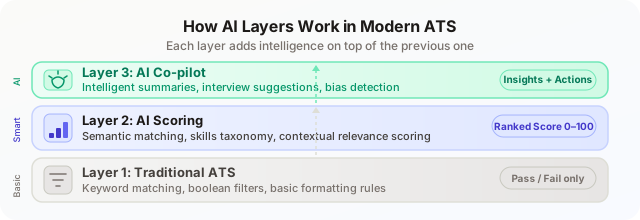
How AI Screening Differs from Traditional ATS
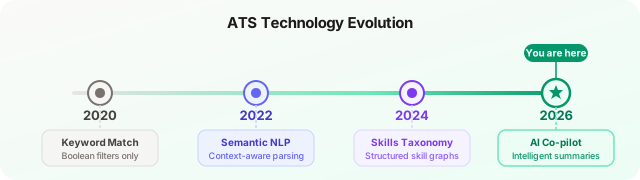
The leap from keyword-matching to AI scoring represents a qualitative shift in how resumes are read.
Semantic understanding vs. keyword matching. Traditional ATS looks for the string “Python” in your skills section. AI scoring models understand that someone who has “built data pipelines with pandas and NumPy” almost certainly knows Python, even if the word never appears. So keyword stuffing, adding a wall of skills with no supporting context, is increasingly counterproductive. AI models learn to discount skill claims that aren’t substantiated by actual described work.
Holistic candidate scoring vs. checklist scoring. Early ATS knock-out filters were blunt: missing “5 years of experience,” rejected. AI models weigh signals together. A candidate with four years of experience at highly regarded companies, rapid advancement, and clearly described impact may outscore a candidate with seven years of undifferentiated work history.
Skills inference from context. AI scoring systems read your entire resume, not just the skills section. If your job descriptions describe the work you did with enough specificity, AI can infer skills you never explicitly listed. This cuts both ways: vague bullet points leave the system with less signal to work with, which means lower confidence, which tends to translate to lower scores.
Predicting culture fit. This is the most controversial aspect of AI screening. Several vendors sell models that predict “cultural alignment” or “team fit” based on resume patterns, language style, and even video interview analysis. The accuracy of these predictions is debated, and their legal status is under active scrutiny in multiple jurisdictions. But they exist, they are deployed, and candidates should know that the way your resume is written, not just what it contains, is being evaluated by some systems.
Which Companies Use What
Not every employer has a sophisticated AI layer. Knowing what you are likely facing helps you calibrate your effort.
Large enterprises (1,000+ employees) and big tech typically have the most advanced stacks. Amazon, Google, Microsoft, Meta, and their peers use proprietary screening tools. Enterprise healthcare, finance, and consulting firms (McKinsey, Deloitte, major banks) have invested heavily in vendor AI scoring systems.
Mid-market companies (200–1,000 employees) usually run standard ATS with some AI features enabled - Greenhouse’s built-in scoring, Lever’s recommendation engine, Workday’s skills graph. These are more conservative than fully custom systems.
Small businesses and startups are most likely to have a human reading your resume first or second, with basic ATS purely for organization. Traditional ATS optimization still applies, but the AI scoring layer is often absent.
Job boards - LinkedIn, Indeed, and ZipRecruiter - have their own ranking algorithms that determine whether your profile surfaces in recruiter searches at all. This is a separate system from whatever the employer uses internally and deserves its own attention.
What AI Screening Models Actually Evaluate
Based on public research, patent filings, and vendor documentation, AI screening systems tend to evaluate several categories of signal:
Achievement patterns. Quantified accomplishments are not just recruiter-pleasing; they are signal-rich for AI models. “Reduced customer churn by 18% over six months by redesigning the onboarding flow” contains role context, timeframe, metric, magnitude, and method. That is five distinct data points in one sentence. A bullet like “improved customer retention” gives the model almost nothing to work with.
Career trajectory coherence. AI models evaluate whether your career makes sense as a narrative. Steady progression within a domain, increasingly complex responsibilities, and logical moves between employers score well. Unexplained lateral moves, long periods of stagnation at the same level, or a history that jumps between wildly different fields without explanation can lower confidence scores.
Skill signal density. How many verifiable skill signals per year of experience does your resume contain? A candidate who describes specific tools, methodologies, and outcomes in each role gives the model more to work with than someone who writes broadly about “managing projects” and “leading teams.”
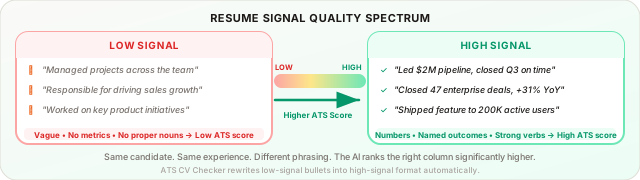
Written communication quality. LLM-assisted screening tools read your resume as text, not just as structured data. Grammatical errors, inconsistent tense, vague language, and padding all degrade the quality of the signal. A resume that communicates clearly, concisely, and specifically reads well to both AI and humans.
Over 98% of Fortune 500 companies now use at least one layer of AI-powered resume screening. Your resume passes through traditional ATS keyword parsing, an AI scoring model, and an LLM summarization tool before a recruiter opens your file. Each layer looks for something different: the ATS checks presence, the AI scorer weighs achievement patterns and career coherence, and the LLM reads your resume as prose and generates a summary that shapes the recruiter’s first impression of you.
The “AI-Generated Resume” Problem
An increasingly common pattern: candidates use AI tools to generate or heavily rewrite their resumes, producing fluent, polished text that nevertheless fails AI screening.
AI-generated resume text tends to be generic. It uses the same sentence structures, the same achievement formulas, and the same vocabulary patterns across millions of documents. AI screening models, which are themselves large language models, are increasingly capable of identifying this pattern. Some enterprise systems are beginning to score AI-generated resumes lower, not on ethical grounds, but because the homogeneity of the language reduces the discriminative signal the model relies on for ranking.
Beyond that, AI rewrites often strip out the specific, idiosyncratic details that make your experience distinct and verifiable. A model that rewrites “built a Kafka-based event streaming pipeline that processed 40,000 events per second for a healthcare data aggregation platform” into “designed scalable data infrastructure solutions to support enterprise clients” has replaced a rich, verifiable signal with a vague claim that thousands of other candidates also make.
Use AI tools to improve your writing, catch errors, and structure your thoughts. Do not let them sand away the specificity that makes your experience real.
Legal and Ethical Context
The regulatory environment around AI hiring tools shifted significantly between 2023 and 2026.
EU AI Act (effective 2025) classifies AI systems used in employment decisions as “high risk.” Employers using AI hiring tools must maintain transparency about the systems in use, conduct bias audits, and provide candidates with the right to request human review of automated decisions. If you are applying to European employers or EU-based multinationals, you have legally-backed options if you believe automated screening was applied unfairly.
US EEOC guidance has issued multiple advisories clarifying that employers remain liable for discriminatory outcomes even when those outcomes result from automated systems. Several jurisdictions, New York City, Illinois, Maryland, have passed laws requiring employers to audit AI hiring tools for bias and notify candidates when automated tools are used.
Document your applications. Note when you receive generic rejections from large employers without any human contact. If you are in a protected class and believe you are being systematically screened out, the legal framework to challenge this is more developed than it was two or three years ago.
A 3-Step AI-Proof Resume Approach
This is not about fooling AI - it is about giving AI screening models enough high-quality signal to evaluate you accurately.
Step 1: Substance before optimization. Write each job description around what you actually did and what actually resulted from it. Use specific numbers, tools, timeframes, and outcomes. If you cannot quantify something, describe the scope: how many stakeholders, what budget, what geographic reach, what complexity of system. Specificity is the foundation everything else builds on.
Step 2: Structure for parsing. Use standard section headers (Experience, Education, Skills). Use consistent date formats throughout (Month Year or MM/YYYY). Do not use tables, text boxes, or multi-column layouts - these break ATS parsers and lose data before the AI scoring layer ever sees it. The ATS resume format guide covers every formatting decision in detail. Keep your file format to PDF or DOCX as specified in the job posting.
Step 3: Verify keyword coverage against the specific job description. This is where targeted optimization happens. The ATS keywords guide walks through a structured method for extracting and prioritizing the right terms from any job description. Read the job description carefully and identify the skills, tools, and concepts that appear repeatedly or are listed as requirements. If you have that experience but have not named it explicitly, add it. Do not add skills you do not have - AI systems that include interview processes will expose that quickly.
Key takeaways
✓ Three-layer screening — your resume passes through ATS parsing, AI scoring, and LLM summarization before a recruiter sees it, and each layer has different failure modes
✓ Context over keywords — AI scoring models read your whole resume and infer skills from described work; keyword stuffing without supporting context is now detected and penalized
✓ Specificity is the foundation — quantified accomplishments with specific tools, timeframes, and outcomes give AI models more signal to evaluate you accurately
✓ Avoid AI-generated homogeneity — AI tools can help polish writing, but removing specific details to sound polished reduces the discriminative signal models rely on for ranking
How ATS CV Checker Helps
ATS CV Checker analyzes your resume against specific job descriptions and identifies where your keyword coverage is weak, where your experience descriptions lack quantification, and where formatting issues may be causing data loss in ATS parsing. It surfaces the gap between what the job description is looking for and what your resume currently signals, which is exactly the information you need to make targeted improvements before submitting.
The tool does not rewrite your resume. It identifies the specific problems so you can fix them with the specificity and accuracy that only you can provide. That distinction matters more in 2026 than it did two years ago.