Project managers miss callbacks because of methodology vagueness, not lack of qualifications. "Agile" and "Scrum" are not synonyms to a trained ATS. PMP certification must include "Project Management Institute (PMI)" as the issuing body for credential verification to register it. Without budget figures, team sizes, and timeline data in your experience bullets, your PM resume scores the same as hundreds of other applicants who list identical soft terms.
Project managers apply to roles where they meet every listed requirement and still don’t get a callback. The reason is usually methodology vagueness. “Agile” and “Scrum” are not synonyms to a trained ATS - you need the specific methodology the job description names. PMP certification must include “Project Management Institute (PMI)” as the issuing body for credential verification to recognize it. Without budget figures, team sizes, and timeline data, your PM resume scores identically to hundreds of other applicants.
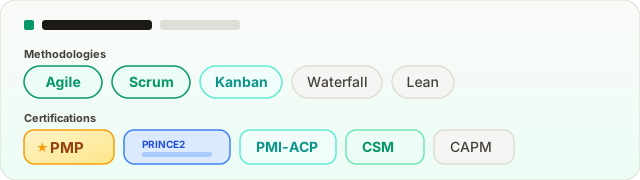
Project management has a certification and methodology vocabulary that is denser than most fields. PMP, PMI-ACP, CSM, SAFe, Agile, Scrum, Kanban, PRINCE2 - these terms are not interchangeable, and ATS systems trained on PM job descriptions know the difference. Getting through screening requires understanding how these systems parse and weight PM-specific credentials. For a full overview of how ATS systems evaluate resumes, see the complete guide.
Why PM Resumes Fail ATS Screening
The most common failure mode for project manager resumes is methodology vagueness. Candidates write “managed projects using Agile methodologies” when the job description is looking for “Scrum” specifically. Or they list “PMP certified” without the PMI issuing body, and the ATS cannot verify the credential against its expected pattern.
The second failure mode is missing the quantification layer. A PM resume without budget figures, team sizes, timeline data, or stakeholder counts gives the ATS nothing to differentiate you from every other project manager. “Managed complex cross-functional projects” is a sentence that belongs to all 200 applicants.
“Agile” and “Scrum” are not synonyms in ATS scoring. A job description that asks for Scrum experience will not award full points for a candidate who only lists “Agile methodologies.” The same applies across the methodology spectrum: SAFe, Kanban, Waterfall, and PRINCE2 are distinct terms with distinct scoring weight. Use the specific methodology name from the job posting, not a category term.
PMP Certification: How to Format It
“PMP” is the most recognized project management credential, but the formatting matters for how ATS systems parse and verify it.
Write it this way in your certifications section:
“Project Management Professional (PMP), Project Management Institute (PMI), Certified 2022, PDU Cycle Expires 2025”
Including PMI as the issuing body allows ATS systems with credential verification modules to confirm the credential against PMI’s registry. For complete formatting rules that apply to all credential types, see how to format certifications for ATS. Including the certification year and renewal cycle gives context about currency.
If you are in the application process: “PMP Candidate - Expected Exam Q3 2026” is acceptable. Do not write “PMP in progress” - it is vague about timing.
After listing in your certifications section, include “PMP” in your skills or your summary as well, since some ATS systems weight credentials more heavily when they appear in multiple sections.
Complementary PMI credentials to format the same way:
- “Program Management Professional (PgMP), PMI, 2023”
- “PMI Agile Certified Practitioner (PMI-ACP), PMI, 2023”
- “PMI Risk Management Professional (PMI-RMP), PMI, 2022”
- “PMI Scheduling Professional (PMI-SP), PMI, 2021”
Agile and Scrum: The Keyword Distinctions That Matter
“Agile” and “Scrum” are not synonyms. “Scrum” and “Kanban” are not synonyms. “SAFe” and “LeSS” are not synonyms. ATS systems configured for PM roles understand these distinctions because job descriptions are specific about which methodologies they require.
How to list your methodology credentials:
- “Certified ScrumMaster (CSM), Scrum Alliance, 2021”
- “Certified Scrum Product Owner (CSPO), Scrum Alliance, 2022”
- “Professional Scrum Master I (PSM I), Scrum.org, 2023”
- “SAFe 6.0 Agilist (SA), Scaled Agile, Inc., 2023”
- “SAFe 6.0 Program Consultant (SPC), Scaled Agile, Inc., 2022”
- “Certified Agile Leader (CAL), Scrum Alliance, 2024”
- “PRINCE2 Practitioner, Axelos, 2023”
For Kanban, there is less standardized certification. If you have completed the Kanban University training: “Accredited Kanban Trainer (AKT), Kanban University, 2022.” Otherwise, describe your Kanban experience in your bullets rather than listing it as a certification.
In your experience bullets, be specific about which methodology you used for which role:
- “Led three-week sprints for seven cross-functional Scrum teams during platform migration, maintaining 90%+ velocity across 18-month program”
- “Implemented SAFe PI Planning for 4 Agile Release Trains, coordinating 140 engineers across 3 time zones”
- “Managed Kanban flow for UX design team, reducing cycle time from 11 days to 5 days over 6 months through WIP limits and weekly throughput reviews”
The specificity matters twice: once for ATS keyword matching, once for human reviewers who want to see that you understand the methodology deeply enough to implement it, not just claim it.
Quantification Patterns for PM Resumes
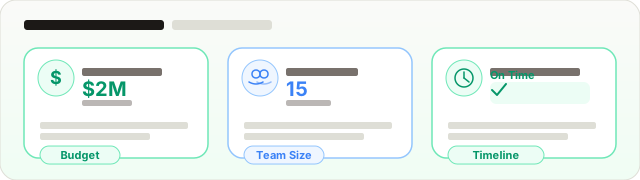
ATS systems for PM roles are trained to identify quantified achievement patterns. These are the numbers that differentiate your resume from generic descriptions.
Budget:
Always state the budget you managed: “$4.2M capital project budget,” “€8M ERP implementation,” “$250K annual operational budget.” If you managed program budgets, state the total: “Oversaw portfolio of 12 concurrent projects with combined budget of $22M.”
Team size:
“Coordinated cross-functional team of 28 engineers, 6 designers, and 3 business analysts.” Give the actual number, not “large cross-functional team.”
Timeline:
“Delivered 14-month system migration on schedule” or “Recovered 6-week timeline slip and delivered on original launch date.” Timeline precision signals project management competence.
Stakeholders:
“Managed stakeholder relationships across 5 business units and 3 external vendor partners” or “Reported to C-suite and board quarterly on program status.”
Outcomes:
Always tie your project delivery to a business outcome where possible: “ERP implementation reduced month-end close from 8 days to 2 days” or “Platform migration eliminated $1.4M in annual legacy infrastructure costs.”
PM Tools: Name Them Specifically
Project management tools are a significant keyword category in PM job descriptions. Name each tool explicitly:
Project management platforms:
- Jira (not “project tracking software”)
- Microsoft Project (not “MS Project” alone - write both forms)
- Asana
- Monday.com
- Smartsheet
- Wrike
- Basecamp
- Linear
- ClickUp
Communication and collaboration:
- Confluence (not “documentation platform”)
- Slack
- Microsoft Teams (not “Teams” alone on first mention)
- Zoom
- Miro (for digital whiteboarding, often used in Agile ceremonies)
Risk and portfolio management:
- Planview
- ServiceNow (for IT PM roles)
- Clarity PPM
- Rally (CA Agile Central)
- VersionOne
Reporting and analytics:
- Power BI
- Tableau
- Excel (list it - it is still required in most PM roles and often specifically called out)
If a tool appears in the job description, it must appear in your resume if you have used it. An exact tool match carries more ATS weight than a general category description.
The PMBOK and Industry Framework Keywords
The Project Management Body of Knowledge (PMBOK) provides vocabulary that PM ATS systems recognize. If you have formal PM training, this vocabulary should appear naturally in your resume.
Key PMBOK concepts that appear in job descriptions and ATS configurations:
- Scope management / scope creep prevention
- Work breakdown structure (WBS)
- Critical path method (CPM) or critical path analysis
- Resource leveling
- Earned value management (EVM)
- Risk register
- Change management (ADKAR, Prosci - specify the framework)
- Stakeholder engagement plan
- Project charter
- Lessons learned
- Project closeout
For IT-specific PM roles: ITIL (Information Technology Infrastructure Library) is a separate but often required framework. List your ITIL certification if you have it: “ITIL 4 Foundation, Axelos, 2022.”
Sector-Specific PM Keywords
The PM keyword set shifts depending on the industry. Match your language to the sector you are targeting. For a full breakdown of PM keywords organized by job title and specialization, see ATS resume keywords by job title.
Technology/Software: Agile ceremonies (sprint planning, daily standup, sprint review, retrospective), backlog management, product roadmap, release planning, feature prioritization, MVP definition, technical debt management.
Construction/Infrastructure: RFI (Request for Information), RFP (Request for Proposal), submittals, punch list, as-built documentation, project closeout, subcontractor management, lien waiver, AIA payment applications, LEED coordination.
Healthcare/Life Sciences: GCP (Good Clinical Practice), FDA 21 CFR Part 11, SOPs (Standard Operating Procedures), IRB approval, clinical trial management, IND application, regulatory submission, validation protocols.
Financial Services: Regulatory project management, change management for compliance, SDLC (Software Development Life Cycle), stress testing programs, CCAR, model validation projects.
Government/Defense: FAR (Federal Acquisition Regulation), DFARS, earned value management system (EVMS), Integrated Master Schedule (IMS), CDRL (Contract Data Requirements List), program baseline.
Writing Your PM Summary
The summary for a project manager needs to communicate four things: your experience level, your methodology fluency, your industry background, and your scale credentials.
A weak summary: “Experienced project manager with a PMP certification who leads teams to deliver results on time and on budget.”
A stronger summary: “PMP-certified program manager with 11 years driving enterprise software delivery and business transformation across financial services and retail sectors. Experienced with Agile at scale (SAFe 6.0 Agilist) and traditional waterfall programs up to $18M. Track record delivering complex multi-vendor integrations involving 60+ person teams while managing regulatory compliance requirements.”
The stronger version contains: PMP (credential), 11 years (level signal), enterprise software and business transformation (specialization), financial services and retail (industries), SAFe 6.0 Agilist (specific methodology credential), $18M (budget scale), 60+ person teams (organizational scale), multi-vendor integrations (complexity indicator), regulatory compliance (domain signal).
Every one of those phrases is an ATS keyword. None of them are vague.
Formatting Decisions for PM Resumes
Single-column layout. No tables for your project list. Reverse chronological work history, with projects described within each role, not in a separate standalone project list.
One common PM resume mistake: creating a “Project Portfolio” section separate from your work history. This breaks the chronological structure that ATS parsers expect, and it severs the connection between your projects and your employers, which affects how the system calculates your career timeline.
Keep projects in their employer context: “At Accenture (2020–2023): Led $12M digital transformation program for retail banking client, coordinating 45 cross-functional team members across 3 locations.”
That structure tells the ATS: employer (Accenture), time frame (2020–2023), project scale ($12M), industry (retail banking), team size (45), geographic scope (3 locations) - all in one parseable sentence.
Key takeaways
✓ PMP with issuing body — write “Project Management Professional (PMP), Project Management Institute (PMI)” to enable credential verification
✓ Methodology specificity — name the exact methodology the job description uses, not a generic category
✓ Budget and team numbers — “$4.2M capital project” and “28-person cross-functional team” differentiate you from candidates using identical soft language
✓ Tool names verbatim — “Jira” and “Microsoft Project” score; “project tracking software” does not match specific tool filters
✓ Projects inside employer context — keep project entries within each role, not in a separate portfolio section that breaks chronological parsing
Run your PM resume against the specific job description before applying. PM roles vary significantly in methodology, industry, and scale requirements. A few targeted edits can move your ATS score from passing to competitive. The ATS resume format guide covers the structural decisions - section headers, layout, file format - that determine whether your resume parses correctly before scoring begins. And the 15-minute tailoring workflow provides a repeatable system for customizing your resume per role without a full rewrite each time.