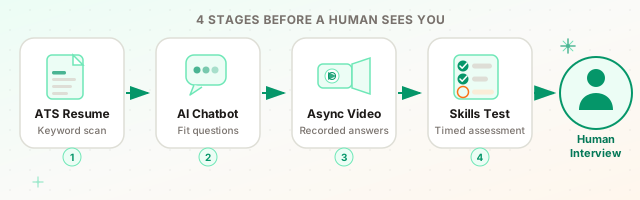
Preparing for a job interview in 2026 means preparing for the automated stages that precede any human contact. 88% of companies use AI to screen candidates before a recruiter reviews an application. 75% of resumes are rejected by ATS before a recruiter opens them. The full interview pipeline now includes ATS parsing, an AI chatbot pre-screen, an async one-way video interview, and a pre-employment skills test before any human conversation begins.
The interview process changed more between 2023 and 2026 than in the previous decade. Not the questions, which are largely the same. What changed is everything that happens before a human recruiter ever speaks to you. Your application now passes through an automated gauntlet: ATS resume parsing, an AI chatbot pre-screen, an async one-way video interview, and a pre-employment skills test. Each stage eliminates candidates automatically. Many people never realize they failed a screen that had no human involved.
This is not hypothetical. 88% of companies now use AI to screen candidates before a human reviews the application. 75% of resumes are rejected by ATS before a recruiter opens them. If you prepare for the interview without preparing for the screens that precede it, you are practicing for a stage you may never reach.
This guide covers both layers of modern interview prep: getting through the automated screening and performing well when you finally sit across from a person.
What Changed in 2026 (And Why Old Advice Fails)
Most interview prep content is still written for the hiring process of 2019. Research the company, prepare your STAR stories, send a thank-you note. That advice is not wrong, but it is incomplete.
The modern hiring process has a 4-stage AI screening gauntlet before the human interview:
- ATS resume parsing — Your resume is scored automatically against the job description. If your keywords, formatting, and section structure do not meet the threshold, the application closes without a human seeing it.
- AI chatbot pre-qualification — Tools like Paradox (also called Olivia) conduct an automated chat screen. It asks qualifying questions about availability, salary expectations, and basic requirements. This is not a formality. Vague or incomplete answers can disqualify you.
- Async one-way video interview — Platforms like HireVue, Spark Hire, and Jobma send you a link with recorded questions. You get 30 seconds to read each question, then roughly 2 minutes to record your answer. No one is watching in real time. No re-recording.
- Pre-employment skills test — Cognitive ability tests, role-specific assessments, or coding challenges, depending on the role. Often pass/fail with no partial credit.
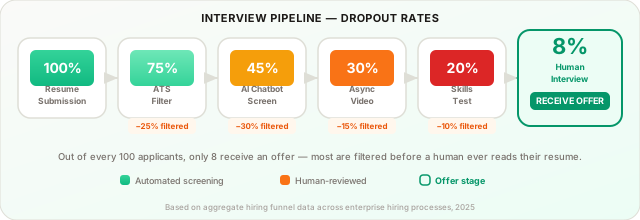
70% of Fortune 500 companies now use HireVue for async video interviews before bringing candidates in for a live conversation. JPMorgan, Goldman Sachs, and Microsoft are among them.
The other thing that changed: what companies call “culture fit” is increasingly framed as “culture add.” Interviewers are explicitly trained to look for perspectives that are absent from their current team. The old approach of researching the company’s stated values and reflecting them back in your answers is less effective. Showing what you bring that they do not already have is more effective.
One more shift worth noting: Google, Amazon, and McKinsey have reinstated in-person interview components after a period of remote-only hiring. The AI cheating backlash is real. Companies discovered that fully remote, asynchronous assessments were easy to game. Expect at least one in-person or live video round to remain in most senior processes.
Step 1 — Audit Your Resume Before the Interview Begins
Most people treat resume prep and interview prep as separate activities. They are not.
Your resume is your script. Whatever language you used to describe your experience (the keywords, the phrases, the specific metrics) is what the interviewer expects to hear you discuss. If your resume says “led cross-functional stakeholder management across 4 product lines” and you describe it in the interview as “worked with other teams,” that gap is a yellow flag. Some HR software actually flags inconsistencies between resume language and verbal responses in recorded video interviews.
Run an ATS score check before your interview, not just before you apply. Use it to verify that the keywords in your resume align with the specific role. Then review your resume the night before the interview and identify the 5-7 claims you are most likely to be asked about. Prepare to expand on each one with specific details.
Your LinkedIn profile matters here too. 65% of hiring managers check LinkedIn before or during the interview process. The dates, titles, and responsibilities on LinkedIn should match your resume exactly. Discrepancies raise questions that interviewers sometimes pursue directly.
Before every interview: read your own resume as if you are the interviewer and write down every claim that could prompt “tell me more about that.”
Step 2 — Research the Company with AI (Not Just the About Page)
The company’s About page tells you what they want to project. You need to know what is actually happening there.
Four research targets that matter more than the mission statement:
Earnings call transcripts. If the company is public, the last two earnings calls are publicly available. They tell you what senior leadership is prioritizing, what is under pressure, and what they are investing in. If the CFO spent ten minutes on the Q2 call talking about cost discipline, showing up with ideas that require headcount is a misread. If the CEO announced a major AI initiative, connecting your experience to that priority is a real advantage.
Recent LinkedIn activity of the hiring manager. What have they posted or commented on in the last 90 days? What problems are they thinking about publicly? This is a free window into their current priorities.
Glassdoor reviews from the last 6 months. Skip the overall score; read the recent text reviews. Look specifically for patterns: what do multiple people mention about the interview process? What do recent reviewers say about management style or team dynamics? This tells you what the culture actually looks like right now, not what it was two years ago.
The company’s AI strategy. This is a new research category that did not exist three years ago. What AI tools are they adopting? Have they announced any AI-related initiatives or layoffs? Where does this role fit in that context? Candidates who understand a company’s AI posture are better positioned to answer questions about workflow and productivity.
For synthesizing this research quickly, a useful prompt: “Summarize [company name]‘s hiring culture and current strategic priorities based on their public Glassdoor reviews, recent LinkedIn posts from their leadership team, and any public earnings call statements from the last two quarters.”
Prepare 3 questions to ask at the end of the interview. Not generic ones (“What does success look like in this role?”). Specific ones that reference your research: “I noticed from your Q3 earnings call that the team is investing heavily in [specific initiative]. How does this role connect to that priority?” Questions like this signal genuine preparation and differentiate you from candidates who prepared nothing.
Step 3 — Prepare for AI Screening Before a Human Sees You
The AI chatbot screen (Paradox/Olivia) is often the first interaction after application submission. It is automated, but your answers are logged and reviewed. Answer every question as you would to a senior HR manager. Qualifying questions about salary, start date, and location requirements are decision points: vague answers can trigger disqualification. Specific answers keep you moving.
HireVue works differently from what most candidates expect. As of 2025, HireVue’s evaluation is primarily NLP-based, analyzing the content and structure of your answers, not your facial expressions. Earlier reporting about facial analysis has largely not held up, and HireVue has moved away from that framing. What it does measure: whether you answer the actual question asked, how well your answer is structured, and whether you use relevant keywords and examples.
Practical setup for your async video screen:
- Environment: Solid background (plain wall or bookshelf), no strong backlighting behind you. Natural light from the front is ideal. Camera at eye level.
- Audio: Use headphones with a microphone if your laptop mic is poor. Background noise trips up NLP transcription.
- Timing: You have roughly 30 seconds to read the question and ~2 minutes to answer. Do not fill the full 2 minutes on every question. A clear, well-structured 90-second answer scores better than a rambling 2-minute one.
- Structure: Use STAR format (Situation, Task, Action, Result) for behavioral questions. State your result early if it is strong: “I increased retention by 23%, here is how” is more compelling than burying the result at the end.
Six to eight prepared STAR stories cover roughly 90% of behavioral interview questions — and the same story adapts to five or more different question types.- **Common mistake:** Treating the async video as informal because there is no live audience. Candidates who are visibly casual or under-prepared in async videos do not get callbacks. Dress, posture, and energy should match what you would bring to a live interview.
Step 4 — Build 6-8 STAR Stories That Cover Everything
Six to eight prepared stories cover roughly 90% of behavioral interview questions. That number is not arbitrary. Fewer than six and you will start reusing the same example for different question types, which interviewers notice. More than eight and your preparation becomes shallow; you cannot develop all of them fully before the interview.
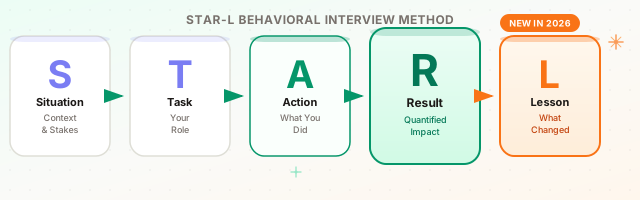
The 2026 update to STAR: add a fifth element. Call it STAR-L.
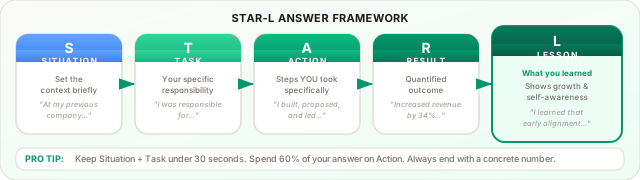
- Situation — context, stakes, constraints
- Task — your specific responsibility
- Action — what you did, specifically (not “we,” “I”)
- Result — quantified outcome wherever possible
- Lesson — what you would do differently, or what you learned
Companies are explicitly asking “what would you do differently?” follow-up questions now. The Lesson element shows self-awareness and intellectual honesty, which senior interviewers weight heavily. Candidates who say “I would not change anything” to a follow-up question almost always lose points.
Every candidate now needs one AI-angle story. Interviewers across industries are asking variants of “tell me about a time you used AI to improve a work outcome.” Prepare a specific answer: name the tool, describe the problem, quantify the result. “I used Claude Sonnet to cut my weekly reporting time from 4 hours to 20 minutes” is a better answer than “I use AI regularly to improve my productivity.”
The same 6-8 stories adapt to many different questions. A story about leading a project under a tight deadline can answer:
- “Tell me about a time you had to deliver under pressure”
- “Describe a time you had to prioritize competing demands”
- “Tell me about a challenge you overcame”
- “What is your greatest professional accomplishment”
Prepare each story, then map it to the five to seven question types it can cover. Adaptability is the point. You are not memorizing scripts. You are having the raw materials ready to assemble in different sequences.
Step 5 — Practice with AI Mock Interview Tools
Reading about interview prep and practicing interview prep are different activities. The research on performance consistently shows that simulation (actually speaking your answers aloud under time pressure) is the only preparation that meaningfully improves verbal performance.
Four AI interview coaching tools with distinct strengths:
- Final Round AI — Real-time coaching. Shows you suggested talking points while you are answering. Best for people who blank on specifics mid-answer.
- Yoodli — Speech analysis. Measures filler words, pacing, answer length, and eye contact. Best for identifying delivery habits you cannot hear yourself.
- Interview.io — Technical and coding interviews. Live mock sessions with experienced engineers. Best for software roles where problem-solving is evaluated live.
- practice.dev — System design and behavioral for tech roles. Structured curriculum with feedback on answer quality.
The minimum effective dose is three sessions. One session is not enough to identify patterns. By the third session you will notice which questions you are answering well and which ones you are avoiding or truncating.
Record yourself and watch the playback. This is the uncomfortable part that most people skip. Watching yourself on camera for 20 minutes teaches you more about your interview performance than any coaching session. Filler words, pacing problems, and answer-length issues are invisible to you in the moment but obvious on playback.
What AI tools catch that human practice partners miss: they are consistent. A friend giving you mock interview feedback will often soften critical observations. AI tools do not. They will tell you that you said “like” 14 times in a 3-minute answer, that you looked at your notes 6 times, and that your last answer ran 47 seconds over the suggested length. That specificity is useful.
Step 6 — Demonstrate AI Literacy Without Being Asked
65% of employers now assess AI literacy during interviews, including for roles that have nothing to do with technology. The assessment is almost always indirect.
Questions that look like workflow questions are often AI literacy questions:
- “How do you handle large volumes of information?”
- “Walk me through how you approach a research-heavy project”
- “How do you stay current in your field?”
- “Describe your process for a deliverable with a tight deadline”
A candidate who answers “I search Google and read through the results” is not communicating the same capability as a candidate who says “I use a combination of [specific tool] and [specific tool] to synthesize large bodies of information quickly; for example, last month I needed to…”
The key is specificity. Vague claims of AI fluency are unconvincing and increasingly common. Specific use cases with named tools and measurable outcomes are rare and memorable.
How to weave AI fluency into any answer naturally:
Instead of: “I managed a complex project with a lot of moving parts.”
Say: “I was managing a complex project with six concurrent work streams. I used Notion AI to keep documentation current and Claude to help me write stakeholder communications that needed to go out quickly, which freed me to focus on the actual coordination work rather than the writing overhead.”
The rule is: name the tool, name the problem, name the outcome. “I use AI tools to be more efficient” is noise. “I used Perplexity to build a competitive landscape analysis in an afternoon that would have taken three days manually” is signal.
What not to say: anything that sounds like AI is doing the work for you. “I just let ChatGPT handle it” communicates a different capability than “I used ChatGPT to generate a first draft, then edited it against our style guide and the specific requirements.” The second answer shows judgment. Interviewers value judgment over tool access.
Pre-interview checklist:
- Re-read the job description and your resume the night before
- Prepare 6-8 STAR stories covering your top achievements
- Research the company: recent news, product launches, challenges
- Prepare 3-5 thoughtful questions for the interviewer
- Test your tech setup 30 min before a video interview
- Have a copy of your resume and the job description open
Day-Before Checklist
- Confirm the interview logistics. Time zone, format (phone/video/in-person), interviewer names and titles, expected duration.
- Test your technology. Open the video platform the company uses (Zoom, Teams, Google Meet, HireVue) and confirm your camera, microphone, and internet connection work. Do this the night before, not five minutes before the call.
- Review your resume and the job description side by side. Identify the three or four points most likely to be discussed. Have specific examples ready.
- Review your 3 company research questions. Make sure they are specific enough to show you actually researched the company, not generic enough to apply to any employer.
- Prepare your physical setup. Clothes (even for video calls, since it affects how you carry yourself), water, a notepad and pen, silence notifications on your phone and computer.
- Set a hard stop on prep. Stop active preparation 2 hours before the interview. Reviewing notes compulsively in the final hour creates anxiety, not confidence.
- Sleep. This is not a soft suggestion. Verbal fluency, working memory, and emotional regulation all degrade significantly with less than 7 hours of sleep. An exhausted candidate with perfect preparation outperforms nobody.
- Prepare for salary questions. If this is a later-round interview, the compensation question may come up. Know your number and know your reasoning. Candidates who negotiate receive on average 18.83% more than those who accept the first offer. You do not need to negotiate aggressively; you need to not reflexively accept the first number.
FAQ
How do I handle a HireVue interview if I have never done one before?
Do a dry run 24 hours before. Most platforms offer a practice question so you can see the interface, test your camera and microphone, and get comfortable with the timing. The format is disorienting the first time because there is no social feedback: no nodding, no “great answer.” Prepare for that. The silence after you finish recording is normal. Stay in frame, keep your posture up through the end of your answer, and stop when your answer is complete rather than filling time with qualifiers.
When should I bring up salary during the interview process?
Not in the first round unless they ask. If a recruiter or HR screen includes a compensation question, give a range that reflects your research: market rate for the role, level, and location. Do not anchor low hoping to seem flexible. Anchoring low signals either that you have not researched the market or that you undervalue your own experience. The actual negotiation happens at the offer stage, when the leverage is highest and where the 18.83% average increase comes from.
Is it acceptable to use ChatGPT to prepare for an interview?
Yes. Using AI to research the company, generate likely interview questions, practice your answers, and refine your stories is smart preparation, not cheating. What is not acceptable is using AI during the live interview to generate answers in real time. Beyond the ethics, it is detectable. Real-time AI assistance tends to produce answers with distinctive phrasing, unusual precision, and a lack of the natural variation that comes from genuine recall. Interviewers who have seen it before recognize it.
What do I do if I completely blank on an answer during the interview?
Say so. “That is a good question. Let me think for a moment” is a normal human response and a better one than filling 30 seconds with filler words while you search for an answer. Pausing to think signals that you are taking the question seriously. If you still cannot remember a specific example after a brief pause, redirect honestly: “I am drawing a blank on a perfect example for that specific situation, but the closest comparable case I can think of is…” This is significantly better than making up a thin example and hoping it holds.
How important is the follow-up after the interview?
More important than most candidates treat it, less important than some coaches claim. A specific follow-up email within 24 hours (not a template, just a sentence or two that references something from the actual conversation) serves two purposes: it confirms your continued interest and it gives you one more data point on responsiveness. A hiring manager who reads a follow-up that says “Our conversation about the Q4 platform migration reinforced why I want to work on this team” forms a different impression than one who receives “Thank you for your time, I am excited about the opportunity.” Generic follow-ups accomplish nothing. Specific ones are worth the 5 minutes.