Cover letters receive much lower scoring weight than resume content in ATS platforms. A strong cover letter cannot rescue a resume that fails keyword matching. At most large employers, your cover letter is not opened until after your resume clears automated screening. Cover letters matter most for small companies with under 50 employees, writing-intensive roles like copywriting or communications, and postings that explicitly require one in the application instructions.
You spent an hour writing a cover letter tailored to the role. You even referenced the company’s latest product launch. Then the ATS parsed your application, scored your resume at 34%, and filtered you out. Your cover letter was never opened. That’s the reality at most large employers. Cover letters get much lower scoring weight than resume content in ATS platforms. A strong cover letter cannot rescue a resume that fails keyword matching. They matter most for small companies, writing-intensive roles, and postings that explicitly require one.
The question is worth answering honestly rather than optimistically: in most cases, no, your cover letter will not be read before your resume is screened by an ATS. That does not mean cover letters are pointless. It means their value is conditional, and understanding the conditions is what determines whether you should spend time writing one.
What ATS Systems Actually Do with Cover Letters
The processing of cover letters varies more by ATS than resume handling does, but the general pattern is consistent.
Most ATS platforms - Workday, Greenhouse, Lever, iCIMS, Taleo - accept cover letters as a separate upload or as a free-text field. When they are parsed, the text is processed similarly to resume text: the system extracts plain text, applies keyword matching or semantic scoring against the job description, and may weight cover letter keywords in its candidate score. However, in most implementations, cover letter content receives significantly lower scoring weight than resume content. The ATS prioritizes structured fields - job titles, dates, skills, education - and the cover letter is often treated as supplementary unstructured text.
Several enterprise ATS platforms go further than simple keyword extraction. Workday’s AI layer and Greenhouse’s newer screening tools apply sentiment analysis and specificity scoring to cover letter text. A letter that uses concrete company names, references specific products or initiatives, and describes targeted value tends to generate a higher specificity signal than boilerplate prose about “being excited by the opportunity.” This is not yet universal, but it is the direction these systems are moving.
What is consistent across all major platforms: the cover letter does not rescue a resume that fails keyword matching. If your resume score puts you below the recruiter’s review threshold, a well-written cover letter makes no difference - it will not be read.
Multiple studies from LinkedIn, Jobvite, and CareerBuilder between 2022 and 2025 consistently found that 40 to 60 percent of recruiters rarely or never read cover letters for high-volume roles. At the same time, 30 minutes spent optimizing resume keywords produces measurably better outcomes than 30 minutes writing a cover letter for a large-company ATS submission. The cover letter is not worthless. It is conditional, and knowing the conditions prevents misallocated effort.
When Recruiters Actually Read Cover Letters
The recruiter behavior data here is discouraging. Multiple studies from LinkedIn, Jobvite, and CareerBuilder across the 2022–2025 period consistently show that 40–60% of recruiters either rarely or never read cover letters for high-volume roles. In markets where a single posting receives 500+ applications, recruiters operate on resume scores and title matching. They do not have time for narrative prose.
The exceptions are real but specific:
1. Small company, direct application. When you apply directly through a company website without routing through a major ATS portal, or when the hiring manager’s email is listed in the posting, there is a higher probability a human sees your application early. At companies with fewer than 100 employees, cover letters are read more often. The filtering overhead of a full ATS is less common at this scale, and hiring managers tend to be more directly involved in initial screening.
2. Roles where writing is part of the job. Copywriters, content strategists, communications managers, PR professionals, technical writers, and anyone else who will produce written work as a core deliverable should treat the cover letter as a work sample. Recruiters for these roles actively evaluate writing quality. A poorly written cover letter for a content marketing position is functionally a negative signal.
3. Roles with explicit instructions to include one. When a job posting says “please include a cover letter explaining your interest in this role” and you do not include one, you have failed a basic instruction. Some ATS configurations flag applications with missing required fields, and at minimum, the absence communicates something about your attention to detail.
When Cover Letters Are Not Worth the Time
Volume applications to large companies. If you are applying to Amazon, Goldman Sachs, Accenture, or any employer using enterprise ATS at scale, a cover letter will almost certainly not be read until after you have cleared automated screening. Invest that time in tailoring your resume instead.
Roles with “optional” cover letter fields. If the ATS offers a cover letter upload but does not require it, and you are applying to a volume role, skip it. The risk-adjusted return on thirty minutes of cover letter writing versus thirty minutes of keyword optimization on your resume strongly favors the resume.
The Cover Letter as a Keyword Vehicle
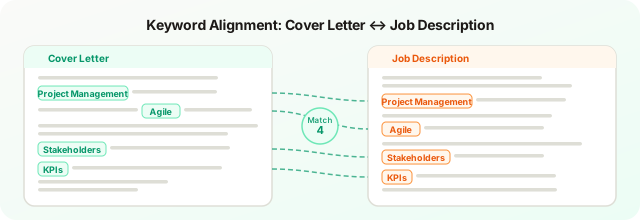
If you are going to write one, use it strategically. Your cover letter text is parsed and indexed, which means it can add keyword coverage for terms that appear in the job description but are not on your resume.
The approach: after writing your resume, run a comparison against the job description. Identify keywords that are required or heavily emphasized in the posting but that you could not naturally include in your resume text. Your cover letter can address these directly in context - describing a specific project, a relevant skill application, or a domain area - rather than listing them artificially.
This is particularly useful for soft skills and behavioral competencies that job descriptions often emphasize (stakeholder communication, cross-functional leadership, change management) but that read awkwardly when inserted into resume bullets. A cover letter paragraph can address these naturally in narrative form.
Structure That Serves Both the Algorithm and the Reader
The conventional cover letter structure still works, because it works for both audiences:
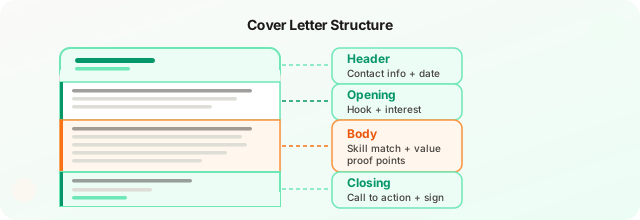
Opening paragraph - specific and direct. Name the role, state your candidacy clearly, and include one specific hook that shows you know what the job actually involves. “I am applying for the Senior Product Manager role. Having spent the past four years building consumer fintech products at [Company], I understand the balance between regulatory constraints and shipping velocity that defines this market” is better than any variation of “I was excited to see this posting.”
Middle paragraph(s) - value alignment. This is where you describe the intersection of their requirements and your experience. Do not summarize your resume. Extend it. If your resume bullet says “Led migration of 2.1M customer records to new CRM,” your cover letter can explain why that project mattered, what the business outcome was, and how it relates to what this company needs. Keep this to one or two paragraphs.
The “why this company” paragraph - this is where most letters fail. Generic enthusiasm (“I admire your innovative culture and commitment to excellence”) adds nothing. Specific knowledge does. Reference a product decision they made, a strategy shift they announced, a market position they occupy. “Your move into embedded finance for SMBs addresses a segment I spent two years underwriting at [Bank], and I have clear views on the credit risk tradeoffs involved” is an opening that a hiring manager will find difficult to ignore.
Close - confident and brief. One sentence expressing interest in discussing further. No need for elaborate sign-off rituals.
Format for ATS Compatibility
Plain text structure in a PDF or DOCX file. No tables, no text boxes, no columns, no decorative elements. These will be stripped or garbled by the parser exactly as they are in resumes. Your letter should be readable as plain text.
Length: one page maximum, which means 250–400 words in practice. Anything longer reduces the probability of a human reader finishing it.
Label the file clearly - “FirstName-LastName-CoverLetter.pdf” - in case it is filed separately from your resume in the ATS candidate record.
The 2026 Factor: AI Sentiment and Specificity Scoring
Several enterprise ATS implementations now apply AI-layer analysis to cover letters as part of candidate scoring. The systems being developed by Eightfold, Paradox, and the in-house tools at large tech companies are evaluating not just keyword presence but specificity and coherence.
A letter that mentions the company’s actual product by name, references a real business challenge in the industry, and makes a specific and defensible case for your fit will score higher on these systems than one that uses generic professional language about motivation and potential. The bar for “specific enough” is higher than most candidates assume. Mentioning the company’s name is not specificity. Referencing their Q3 strategy shift and explaining why your background is directly relevant to it is.
Video Cover Letters
A small but growing subset of employers - primarily early-stage tech companies and some creative industry roles - now request short video introductions in place of or alongside traditional cover letters. These are typically 60–90 second self-recorded clips submitted through platforms like Loom or the employer’s own hiring tool.
ATS systems do not analyze video content in most implementations; the video is attached as a link to the candidate record for human review. The substance considerations are similar to written cover letters: specific, direct, and focused on what you bring to the role rather than how excited you are to be applying. The key failure mode to avoid is reading from a script - it reads as low-effort and rarely delivers the “communication skills” signal that video requests are designed to evaluate.
The Practical Decision Framework
Write a cover letter when: you are applying to a small employer with a named hiring contact, the role requires demonstrated writing ability, the posting explicitly requests one, or you have something specific to say that your resume cannot contain.
Do not write a cover letter when: you are submitting through a large-company ATS portal with no specific human contact listed, the field is marked optional, or you are in a volume-application sprint and the time is better spent on resume tailoring.
Key takeaways
✓ Resume first, always — a cover letter cannot rescue an application that fails ATS keyword matching; it is never read if your resume score is below the review threshold
✓ When it matters — cover letters are read and evaluated at small companies, for writing-intensive roles, and when the posting explicitly requires one
✓ Keyword vehicle — use the cover letter to add natural coverage for competencies the job description emphasizes but that read awkwardly as resume bullets
✓ Specificity over enthusiasm — referencing the company’s actual product or strategy in concrete terms scores higher with both human readers and AI sentiment analysis tools than generic professional language
When you do write one, make it specific enough that it could only have been written for this company and this role. A generic cover letter is worth exactly as much as no cover letter - which, for most ATS submissions, is nothing.
Keep reading: